If what you like about basketball is high-octane offense, elegantly executed offensive sets, and great scoring performances from stars, then the Los Angeles Sparks’ 76-68 victory over the San Antonio Silver Stars was probably agonizing.
However, there is something equally compelling about the level of defensive intensity that both teams played with last night that seems to add to the drama of transitioning from the regular season to the playoffs.
The type of defense played last night is not only indicative of a level of aggression, grittiness, and tenacity not normally associated with women’s sports, but also makes the anxiety and sense of urgency of the playoffs start to become tangible.
It’s easy to write off last night’s game as merely an example of poor basketball by pointing to the 16-16 first quarter or the Sparks’ abysmal second quarter in which they shot 28.6%. And as with any game there were missed assignments or mental lapses.
Instead, I suggest that the defining element of both halves was the defensive tone that was established early and particularly caught my eye on a play in which Silver Stars center Ann Wauters made a stop on Sparks forward Candace Parker.
It’s rare to see a Rethinking Basketball post focused on defense, which is somewhat ironic considering that I was a defensive specialist for most of my non-descript organized basketball career. As such, this season I’ve been keeping track of defensive statistics, no matter how futile a cause it may seem.
Defense is probably the most difficult thing to analyze in basketball because there really is no reasonable way to assess it without knowing a) the team’s scheme, b) the overall strategy that the scheme is part of, and c) what is expected of each individual within that strategy.
For example, there are times when a team will live with giving up one thing in hopes of shutting down another. Play to play it might look like “bad defense” on the part of a player when it reality it’s a reasonable strategy to win a game given the personnel. What might seem like a lapse in one situation, may be a stroke of brilliance in another.
The Silver Stars used a creative defensive scheme in the first quarter to keep the Sparks off balance, playing a man defense that functioned something like a zone when players switched.
For example, with 8:55 left in the first, Sparks point guard Noelle Quinn set up the offense for the Sparks and initiated the play by dribbling around a Parker screen on the right wing. Normally on a screen such as that against a man-to-man defense, one would expect a simple exchange of defensive assignments in which Becky Hammon who was guarding Quinn would stick with Parker and Sophia Young would switch from Parker to Quinn.
Instead the Silver Stars made a much more complicated move. Young did step up and stop Quinn, who was clearly setting up a play to Parker, who was rolling to the basket. But rather than Hammon picking up Parker, Ann Wauters – who was sagging way off Lisa Leslie -- picked up Parker and Hammon picked up Leslie who was at the top of the key.
Confusing? Yes, and it’s just as confusing if you have to play against it. That’s the point.
And the Silver Stars did it all game to great effect. It wasn’t until halftime adjustments were made that the Sparks were able to really turn a corner.
Of course, part of the Sparks second-half turnaround was a matter of running more of a fluid motion offense rather than standing around trying to merely exploit their size advantage in the post. Nevertheless, what stifled the Sparks repeatedly in the first half was the Silver Stars defense.
But what actually got my attention is when the uber-athletic Parker actually went to make a move against Wauters on the same play.
Parker took two dribbles with her back to Wauters, subtly giving shoulder fakes to try to catch Wauters off balance and make a spin and drop step. When Parker finally did turn and make a drop step, Wauters did not budge and was able to bother Parker’s shot and send it off the far side of the rim strong.
Obviously, this was a combination of good scouting and good defensive strategy that made that entire sequence happen. But the reason it grabbed my attention is that those are the type of defensive plays that don’t show up in the box score and often go unnoticed.
In the second half, it was the Sparks’ defensive intensity that defined the game flow as the Sparks just used their size and physical advantages to prevent the Silver Stars from doing much of anything – finding scoring opportunities, making interior passes, or even cutting through the lane.
Moreover, the Silver Stars didn’t get to the free throw line once in the third quarter, which was a result of the Sparks defense, regardless of whether the game was called perfectly (no basketball game in history ever has been to my knowledge).
Both sides played physical in the post throughout the game and most of the time it was simply a matter of being disciplined enough to hold one’s position, resist the temptation to bite on fakes or wilt at the sign of any potential contact, and being willing to take a hit and not back down.
And despite the obviously strong defensive play exhibited by both teams, the Silver Stars finished the game shooting 44.6%, while the Sparks shot 50%, including 70% in the second half on 19-29 shooting from the field.
When you combine that type of gritty play with strong offensive play you get what I consider the best of basketball.
It’s not just about the pretty highlight reel plays that excite us on the most basic level. It’s the ongoing chess match from play to play of each team trying to one up the other – on both sides of the ball – and constantly making adjustments, forcing their opponents out of their comfort zone, and improvising as a unit to try to tough out a win.
It’s not the prettiest thing for fans to watch, but it’s good all-around basketball that I have great appreciation for. It seems to give the game an edge that draws you into the competition and helps the player’s passion come alive.
And for a junkie like me, that’s beautiful.
Continue reading...
Defense Defines Sparks Victory Over Silver Stars


The Los Angeles Sparks: "Expect Anything"
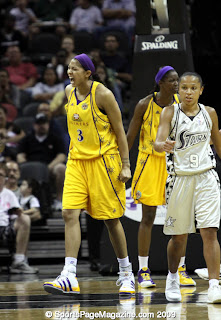 After the Los Angeles Sparks' 67-66 overtime road win over the Silver Stars last night, San Antonio forward Sophia Young perfectly articulated why this was the one game I was looking forward to seeing all week.
"With LA we expect anything,'' said Young. "It's always going to be a good game. They never blow us out, we never blow them out, and it's always an exciting game for the fans.''
Too bad nobody could see it on WNBA LiveAccess...because there's more than one reason to want to watch the Sparks.
Consistent with Young's statement, this was a tightly contested game, perhaps even an ugly one. Looking at the Four Factors statistics, the only major thing separating the two teams last night was the Sparks' dominance on the offensive boards, which is typical of when these teams play.
Combined with the San Antonio Silver Stars' uncharacteristically low assisted field goal percentage -- meaning they were not moving the ball well -- the Sparks got enough of an edge to pull this one out.
However, what makes the game more significant is that it marks a major turning point for the Sparks season -- the night when they became a legit playoff team. Not just because the Sparks moved into third place in the Western Conference after an abysmal start to their season, but also because of how they did it.
The Sparks beat the defending Western Conference champion Silver Stars in San Antonio in a (seemingly) gritty overtime battle to extend a 3 game winning streak to 4.
That’s the type of game hungry and serious playoff contenders win, not only because they have to fight for playoff position, but just to prove to everyone else that they are a team to beat. It forces us to shift our thinking about the Sparks from wondering about what has transpired thus far this season to wondering what might come to pass in the post-season.
And that’s what makes this most significant to me and the reason why I’ve taken an increasing interest in the Sparks since the All-Star break.
Los Angeles fans shouldn’t be the only celebrating the Sparks transition into a legit playoff team. The Sparks are in the midst of constructing what could become one of the league’s great narratives…and that’s good for anyone who cares about the health of the WNBA.
Having center Lisa Leslie make a deep playoff run in her final season and Parker emerging as a real post-season performer after all the mess of a season this has been for them so far really is a great story that sports fans should be able to step into.
Leslie and Parker are arguably the two most prominent women’s basketball players in the U.S. Dramatizing the transition from one to the other with a successful final run for Leslie is exactly the jolt the league needs.
Given the narrative of this season – maternity leave, injuries, inconsistent rotations – having those two at the center of a successful turnaround also creates a hero narrative for the WNBA that is so rarely applied to women’s team sports. It gives people reasons to continue following.
Part of what attracts people to pro sports are hero narratives – people we can root for and who accomplish things that we can only imagine. People who can overcome adversity when everyone has counted them out and persevere to reach the top of their craft.
We can talk all we want about how basketball is a team game and that's what makes it beautiful, but let's be real: it's individual figures like Los Angeles Lakers legend Magic Johnson that make leagues successful.
I’m not saying I am rooting for the Sparks to win it all. But it’s hard to deny that every step closer they get to the WNBA Finals from this point on will be good for the WNBA.
Continue reading...
Hammon's Playmaking Ability Beats Lynx: Is Hammon the Best Point Guard in 2009?
 With 12 seconds left and the game tied at 87, San Antonio Silver Stars’ All-Star guard Becky Hammon stood near the mid-court line and faced up one-on-one against Minnesota rookie forward Rashanda McCants.
As she dribbled the clock down to about 7 seconds before really making a move to initiate a play, it seemed logical that the Silver Stars had put the ball in Hammon’s hands to take the final shot.
And why not?
Hammon is one of the craftiest offensive weapons in the WNBA and a rookie didn't seem to stand a chance against her.
With about five seconds left, Hammon dribbled around a Sophia Young screen, in a play that seemed to be a pick and roll. With Young quickly covered by Lynx defensive stalwart Nicky Anosike in the paint, Hammon kept the ball, temporarily mishandling it after taking one of those “not me” bumps from Lynx forward Tasha Humphrey on the wing.
Then Hammon worked some All-Star magic and showed why she's among the league's best players.
Hammon kept the ball for herself turning the corner and splitting McCants and Lynx guard Renee Montgomery. With two seconds left and Anosike in between her and the basket, Hammon took to the air trying to hit a running jumper. Seeing that she had no shot with Anosike in front of her and two other players around her, Hammon spotted center Ann Wauters wide open just inside the free throw line after Humphrey got lost on the rotation after bumping Hammon on the wing.
Wauters hit an uncontested jumper at the buzzer, sending the Lynx home with an 89-87 loss after a hard-fought fourth quarter comeback.
Add the Lynx to the list of teams who have been victimized by Hammon’s playmaking ability.
She set up a similar buzzer beating play to All-Star forward Sophia Young for a Silver Stars victory over the Storm on July 28th. But she’s also been dominant in losses to Sacramento, Seattle (August 1st), and Atlanta.
Nevertheless, when I talk to people about the league’s best point guards this year, they’ll normally list Sue Bird, Lindsay Whalen, Lindsey Harding, and then Temeka Johnson.
When they come to Hammon, they give a response like, “Well, she’s a great player, but not really a point guard.”
To be honest, since I’ve started watching the WNBA consistently last year, that’s how I’ve felt about Hammon. Despite the fact that WNBA GM’s voted Hammon as the third best point guard in the league in the pre-season survey (tied with Ticha Penicheiro and Katie Smith), it has always struck me as difficult to cast her as what people might traditionally consider a point guard.
Hammon definitely handles the ball well enough to be considered a point guard, but shoots the ball enough to seem more like a shooting guard. It has thus been tempting to cast her as a small scoring guard instead of a point guard.
However, after watching her in person at Key Arena on August 1st and against the Lynx last night, I think it’s probably time that we stop qualifying statements about Hammon and just consider her a point guard.
And if we consider her a point guard, has any point guard in the league been better this season?
Probably not.
What is a Point Guard?
Coincidentally, an article from a San Antonio NBA blog entitled "What is a Point Guard?" holds some insight into how we might expand our traditional notions of who “counts” as a point guard.
The blog essentially characterizes a point guard in much simpler terms than I have in the past with my analysis of point guard styles:
Once it is established that a player can effectively bring the ball up the court and initiate the offense – which is no easy task against pro-level athleticism and defense – defining a point guard is more a matter team-specific expectations than a rigid set of attributes.
He uses Tony Parker as an example of how a point guard fits within a specific system:However, it's not just individual man-to-man pressure that a point guard has to handle. They also have to handle traps both full court and half court. At times last year, George Hill struggled with all three. Full court man-to-man. Full court traps. Half court traps. When he struggled, we ended up with Bruce bringing the ball up court or a turnover. Neither of which is conducive to the Spurs scoring.
Of course, Parker’s particular style of play and athletic attributes are not necessary to play the point guard position – we can all think of a range of much slower and non-scoring point guards who have played the position well over time (Mark Jackson comes to mind).
Why don't teams do this against Tony? Well, a couple reasons. One, Tony is a very good dribbler. He is very difficult to trap because of both his dribble and quickness. Because of this, he can frequently beat the trap alone which puts the Spurs in a 5 on 3 situation. If the other team puts full court man-to-man pressure on Tony, Tony is usually fast enough to blow by his man which leads to a 5 on 4 situation. In short. Tony is dangerous offensively. The Spurs run a lot of very high screens to be able to have him shake his man and attack a big at the free throw line. Why would the other team GIVE them this situation by employing a full court press? The answer is, they don't.
The same type of analysis could be applied to any basketball team in order to establish what they might expect from a point guard: what are they trying to accomplish? And does this particular player allow them to do it?
Hammon-as-Point-Guard
The reason people may tend to disregard Hammon as a point guard is that she might appear to be spending more time scoring than initiating a team’s offense.
Her assist ratio – the percentage of plays on which she creates an assist -- is18.53%, just outside the top 50, well below that of most point guards in the league. Her pure point rating – a metric that measures how well a player creates scoring opportunities for others when on the floor – is also just outside the top 50 and well below that of the league’s top point guards.
In addition, although she is a rather efficient scorer, she is also a volume shooter. So when you add it all up, it just seems that Hammon would not be the type of player whom we would label a point guard.
However, what Hammon does extremely well is use the threat to score as a means by which to create opportunities for others. She’s not a point guard who is racking up assists just by swinging the ball to an open shooter – Hammon is often driving and forcing the defense to shift in ways that create open shooters.
And right now, Hammon is doing the job of creating scoring opportunities for others better than anyone else in the WNBA.
If being a point guard comes down to a matter of decision making – more specifically, making the decisions that help their team score points – then understanding Hammon as a point guard should come down to an evaluation of her decision making. If she is the best scorer on the floor in almost any game she plays, then creating scoring opportunities for herself is actually a good decision.
Her team needs a player who can penetrate and create offense for themselves and they need someone who can get the ball to All-Star forward Sophia Young and center Ann Wauters. Hammon’s ability to make efficient scoring decisions in addition to finding ways to set up others should put her in conversations as one of the best – if not the best -- point guards in the league.
But maybe the discussion of how we classify Hammon really doesn’t matter. Maybe it’s sufficient to just say she’s a great player, as Sue Bird commented after the Silver Stars' August 1st loss in Seattle. “She’s such a tough player,” said Bird, who guarded Hammon at times throughout the game. “She’s really, really creative. Really, really deceptive. She’s able to separate herself, even at her height, against players that are 6-5 and get her shot off. And I think the one thing I would use to describe her – the one quality – is that she’s just a winner. And she makes plays down the stretch that not many people in this league can make.”
If Hammon can win enough games to get the Silver Stars to the playoffs, she will be a strong candidate for MVP of the WNBA.
Transition Points:
Renee Montgomery was very impressive down the stretch of this game, ending a 12-0 run by the Silver Stars in the 3rd quarter and catalyzing a 10-2 Lynx run in the 4th that got started the Lynx’s comeback. And really for Montgomery it was more of the same – her outstanding ball handling ability allows her to get by defenders and get herself open for layups off the drive. Her athletic ability makes her an extremely effective finisher.
But the most impressive thing about Montgomery to me is her defensive intensity. She’s tough and willing to take on just about any defensive challenge. With her athleticism, she’s able to stay in front of most players in the league and pick up steals. If she develops her range and continues to grow as a defender, Montgomery may be among the top point guards in the WNBA in the near future.
Continue reading...
Storm-Stars Preview: A Battle of Supporting Casts
In the Seattle Storm’s 74-71 loss to the San Antonio Silver Stars on Tuesday night, the Silver Stars came back from down 10 points at the beginning of the fourth to win the game on a last second three pointer.
All-Star guard Becky Hammon had an all-star caliber game with 24 points and all-star forward Sophia Young made an all-star caliber three point shot to win the game at the buzzer.
However, what really made the difference in that game was the supporting cast for the Silver Stars and in particular, the play of Megan Frazee.
Although Young made headlines for her buzzer beating three point shot, she had a difficult game going 5-17 from the field and 2-11 inside the three-point line. The Storm’s taller defenders in Lauren Jackson and Camille Little made it extremely difficult for Young to score inside, at times not even drawing rim on shots around the basket.
For a team whose success last season was predicated on strong post play in addition to Hammon’s perimeter play, supported in particular by center Ann Wauters who has yet to return this season, Young’s struggles necessitated someone to step up and bring a post presence.
San Antonio coach Dan Hughes called upon Frazee and she did not disappoint.
Frazee was extremely efficient from the field, going 7-10, including a three pointer in the second quarter. She fought for a number of difficult rebounds with Storm post players finishing with 7 overall, including two offensive rebounds. She didn’t even miss a shot until late in the fourth quarter.
On both offense and defense, Frazee was often in the right position, even if she didn’t make the spectacular play. And it seemed like just when the Storm started to get momentum, Frazee was there to make a play that swung the momentum in the opposite direction.
For a rookie – who wasn’t even mentioned in my last rookie rankings, but will have my attention in the future – Frazee was impressive.
The Storm’s dynamic All-Star duo of Sue Bird and Lauren Jackson had solid games but got considerably less production from their bench.
So heading into tonight’s game, what are some of the key things to watch for?
Frazee is obvious after her previous performance, but their previous match up also illuminated some other things to watch for.
San Antonio: Sophia Young’s jump shot
Young was 2-11 from two point range in the previous game and although a lot of those shots were contested, she also missed a few jumpers that she could easily have made.
In the past, Young has been most successful when she’s been able to put pressure on her defender by scoring off drives and from the perimeter. If she had gotten that game going against the Storm, the game might have had a much different outcome.
San Antonio: Ball movement
When San Antonio keeps the ball moving they are extremely successful. And a lot of that is due to the passing of their post players.
And it just so happens that those defensive rotations are something Seattle has struggled with throughout the season.
What makes the Silver Stars so difficult to defend is that if you go zone to stop stymie their post play, they pass the ball so well to their shooters that they’re able to punish you from the perimeter. If you go woman-to-woman defense, they move the ball and force the defense to rotate until something opens up.
The answer is to have great on ball defenders and unfortunately the Storm struggled to guard the Silver Stars’ shooters and gave up 14 offensive rebounds, which led to 13 second chance points.
Seattle: Tanisha Wright driving
A major reason for the Storm’s 10 point lead at the beginning of the 4th quarter was Tanisha Wright’s ability to put pressure on the defense by driving to the basket and either scoring or passing was essential.
Wright did not end with a bad game – she just didn’t have a very consistent game. Outside of the third quarter, she was not a big factor.
The Silver Stars came out in the 4th quarter in a zone which stopped the penetration and led to the Storm looking a lot more stagnant. Meanwhile, the Silver Stars got hot on offense and erased the big lead, with the support of their crowd of course.
Unfortunately for the Storm, Wright was essentially a non-factor for much of the game and that really hurts the Storm because Wright’s aggressive penetration has been a key factor in the Storm’s victories this season. Whether it means drawing up more plays for Wright to make things happen consistently to put the pressure on or moving her around to get more favorable matchups is hard to say. But when she is on consistently, the Storm are a very difficult team to beat.
Seattle: Bench play
While the Silver Stars’ bench, led by Frazee, had a very productive game contributing 22 points, the Storm only got 5 points from their bench.
When Young struggled for the Stars, someone from their bench stepped up. When Sue Bird, Tanisha Wright, Camille Little, or Swin Cash were absent for stretches, the Storm simply didn’t get support from their bench.
While it’s great that the Storm got double digits from each of their starters, they also need production from their bench in order to keep their opponent on their heels.
Who will step up tonight?
Continue reading...
Los Angeles-San Antonio Scouting Report: Offensive Rebounding is the Key
Based on their record, San Antonio has to be considered a favorite to win the WNBA championship right now.
They’ve arguably been the most consistent team in the league, not losing more than two in a row and they’ve only lost two games at home.
But they have one glaring, consistent weakness – defensive rebounding, reflected in their opponents’ offensive rebounding percentage in losses. And if their last meeting is any indication, the Sparks will look to exploit that weakness when they meet the Silver Stars tonight in Los Angeles.
In their last meeting, the Sparks dominated the paint getting 18 offensive rebounds to the Silver Stars 1. That’s right – one offensive rebound the entire game. The height and length of the Sparks’ frontcourt was just far too much for the Silver Stars, not only dominating the glass, but also shutting down Sophia Young, holding her to 1-5 shooting from the field.
The Sparks would do well to repeat the strategy when they face the Silver Stars tonight, but was that just a fluke? And with a battle-tested strategy going in, do the Silver Stars even have a shot to win? The team dynamics numbers provide some cogent insight
The Sparks rely upon offensive rebounding to win
The Sparks aren’t leading the league in offensive rebounding and that’s because the teams ahead of them – Detroit, Houston, and Sacramento – are much deeper in the frontcourt. But having 2 of the top 10 offensive rebounders in the WNBA (Lisa Leslie and Candace Parker) puts a lot of pressure on opposing defenses.
Parker and Leslie are in the low post grabbing offensive rebounds, they’re also talented enough to score second chance points and those are what really hurt the Silver Stars. It gives the Sparks a bunch of high percentage baskets from their most highly skilled players.
It’s doubtful that the Silver Stars will shut down the Sparks on the offensive glass, so they might just have to bite the bullet and accept that a) the Sparks will get offensive rebounds and b) they will get a number of second chance point. But the key is to try to hold the Sparks to a more reasonable number of rebounds, like somewhere around 10 instead of the 15 or 18 they had in the first two meetings.
And the Sparks can also win with defense
The Silver Stars rely upon offensive synergy, moving the ball well and finding open scorers from good passing and cutting rather than one-on-one play. But in their last game against the Sparks, they were shut down. Why?
Two of San Antonio’s top scorers are in the post and obviously, the Sparks strength is the post defense of Leslie, Parker, and DeLisha Milton-Jones. In the last game against the Silver Stars, the Sparks chose to key in on Sophia Young in particular.
Young is arguably the most valuable player in the league and certainly the most valuable player on the Silver Stars – she’s efficient, versatile, and has one of the top plus/minus and efficiency ratings in the league. Young is typically a player scores by moving from the outside in, using her quickness to score on cuts to the basket or facing up her opponent.
But the key stat in understanding how dependent the Silver Stars are on Young is that in games won, she is shooting 52.6% and in games lost she’s shooting 42.7%. That’s a huge difference and neither Becky Hammon nor Ann Wauters has such a huge effect on wins and losses.
So the Sparks' strategy of shutting down Young is definitely sound. And with bigger players like Leslie, Milton-Jones, and Parker who are able to stay with Young on the ball and help off the ball, Young becomes a non-factor. If they bring the same defensive intensity they showed against the Monarchs on Thursday night, they should be able to win.
But the Sparks also commit turnovers more often than any team in the Western Conference
So far this season the only teams who commit turnovers more often than the Sparks are the Fever and Mystics, not exactly shining examples of ball control. And in addition, the Sparks have the highest turnover differential in the league, committing almost three turnovers a game more than their opponents. And when they lose, you can be almost certain that they turned the ball over a lot, even when they do well on the offensive boards.
When the Sparks are at their best, they’re moving the ball well and allowing Leslie and Parker to play off each other in the high-low post game. But if a team can pressure their guards, force them into turnovers, and force them to revert to one-on-one basketball, the Sparks become a very beatable team.
However, it’s always worth noting that the Sparks' turnovers are not limited to their guards – it’s Leslie, Milton-Jones, and Parker who lead the team in turnovers. Part of that is because they are often forced to become playmakers when the team’s guards falter.
We should also look at the type of turnovers they’re making. On Thursday against the Monarchs, they had a characteristically high turnover game, but also managed to have a high synergy score. They did an extremely good job of looking for Parker in the post with lob passes and a lot of those passes caused turnovers. So it was one of those cases where they were making turnovers in the process of taking measured risks…not just tossing the ball away or making ball-handling errors.
Nevertheless, given that they are a turnover prone team, the way to beat them seems to be by forcing them out of their offense and into turnovers.
Edge: Sparks
I’m giving the edge in this game to the Sparks not only because of the offensive rebounding problem the Silver Stars have, but also because I expect the Sparks to come out with the same renewed sense of purpose and urgency that they showed against the Monarchs. And if they bring the same defensive intensity, the Silver Stars will be in trouble.
If the Silver Stars could turn the game into a shootout and get the Sparks caught up in trying to play a perimeter game, things could turn out differently than the last game. But I see no reason to believe the Sparks won’t try to use the same high-low strategy we saw against the Monarchs last night that worked against the Silver Stars.
Transition Points:
The Sparks started Shannon Bobbitt and Keisha Brown last night in the backcourt which I thought was an interesting choice. But it makes sense – if you can’t depend on one ball-handler, why not divide the ball-handling responsibilities between two players and allow different points of attack?
Continue reading...
Finding the formula for team chemistry…or dynamics…or cohesion…or something…
A few weeks ago, PT from the Pleasant Dreams blog commented that “chemistry” didn’t seem like quite the right word to describe what I’m looking at since that implies that players don’t get along with each other. But I recently got some clarification on that.
Eric Musselman, a former NBA coach who blogs about basketball and observations on sports coaching had a post last Friday entitled, “Finding the formula for team chemistry”. He cites an article from Pat Bloom, the head baseball coach at the University of Wisconsin- Stevens Point, that separates chemistry into two types – task cohesion and social cohesion. Uh oh… more terms…but the explanation is insightful:
Task cohesion "refers to a team’s ability to function as a collective unit and perform effectively on the field. If your team has a high level of task cohesion, meaning that they play well together and remain united in the pursuit of the team’s goals, then they are more likely to enjoy success."It would be interesting to find a way to read more about the theory that teams that are high in social cohesion play worse as a team, but that’s besides the point for my current task. The point here is that finding ways to measure task cohesion is of huge importance to basketball analysis.
Liking each other, simply being friends and enjoying hanging out together, i.e., a team with high social cohesion, "means very little in the way of predicting your team's performance." In other words, just because your team gets along doesn't mean they'll win any games.
In fact, according to Coach Bloom, "it has even been found that teams who are high in social cohesion play worse as a team."
But a team with high task cohesion isn't guaranteed to succeed. However, there's good news for basketball coaches, according to Coach Bloom.
"For team sports like basketball and ice hockey, where players’ movements and verbalizations must be highly interactive and coordinated to achieve success, it has been found that greater levels of task cohesion relate to greater team success."
So during the break, I spent some time looking more deeply at the “team dynamics” ratings I have used in the past to make them more useful for analysis. Here’s what I came up with.
Deriving a formula
Originally I started my analysis with the concept of synergy, which was a metric created to say something about a team’s offensive cohesion by adding their assisted field goal percentage to their true shooting percentage. I then looked at a team’s opponent’s synergy to get a sense of their ability to disrupt the opponent’s synergy. Thus, I used synergy differential to measure defensive and offensive task cohesion.
However, synergy differential didn’t seem to do much to explain why a team won and lost, so I added other statistics based on things that seemed to explain why certain teams succeeded despite having low synergy – offensive rebounding rate and turnover rate.
So then you have the following formula, which I have called "Team Dynamics":
(Team synergy – opp. Synergy) + off reb rate – turnover rate = team dynamics rating
Essentially, those numbers described the core principles of basketball: the ability to move the ball to create high percentage scoring opportunities, the ability to disrupt the other team’s offense, and the ability to manage possessions effectively. In terms described by Bloom above, team dynamics are used to measure the degree of cohesion for a given team.
However, that still didn’t fully describe why teams win or lose – unfortunately there were six games in which the team with the higher team dynamics rating lost. And so I tweaked the formula again.
Adding the fifth factor of team dynamics
You may notice that the formula bears a striking resemblance to Dean Oliver’s Four Factors. However, there was one factor I left out as I “derived” the formula from common basketball sense – free throw rate.
Free throw rate is a ratio of free throws made to field goals attempted. In plain language, it describes the percentage of their offensive production that comes from the free throw line. An opponent’s free throw rate says something about how many free throws a team is allowing, which is also a proxy to how much they are fouling.
When I added that to the existing formula it described the winners and losers in every game except one -- Los Angeles vs. New York on Friday, July 25th (Los Angeles had a huge fourth quarter and a massive offensive rebounding advantage in that game). But that also required an additional change – instead of using true shooting percentage (which includes free throw and three point shooting), I switched to effective field goal percentage (which just weights three point shots more heavily).
In addition, I realized that looking at synergy differential over the course of a season was not that useful – synergy will vary from opponent to opponent depending on match-ups, so it’s more useful to just know a team’s average differential and compare it to the opponent they’re facing. So here’s the new formula:
Team synergy + off reb rate + free throw rate – turnover rate
But now there’s an additional problem – it only measures offensive cohesion. But there’s a very simple solution to that based on what I’ve done with game analysis – it’s simple one team’s offensive cohesion vs. the other’s. So the opponent’s offensive cohesion really tells us quite a bit about a team’s defense. So over the course of a season, if we look at a team’s offensive cohesion and their defensive cohesion based upon their opponents’ statistics, we get an offensive and defensive cohesion rating.
Why is this useful?
The reason I find this useful is that it’s not just a simple way of comparing teams to see how they’re playing, but it also allows us to say something about why a team is playing well or poorly on both sides of the ball.
When we want to know what happened in a game or even in a given quarter, these numbers give us the opportunity to actually tell a story of what happened beyond the final score and why a team won or lost. For a basketball geek like me, it’s extremely helpful just to get an idea of what makes each team tick.
So here are the team dynamics numbers for each team (their overall offensive and defensive numbers are on today’s other post):
| Team Dynamics | |||||
| Team | Synergy | OReb Rate | FT Rate | Tov Rate | Differential |
| Seattle Storm | 70.47 | 30.98% | 26.32% | 18.30% | +8.82 |
| Connecticut Sun | 72.78 | 31.19% | 23.90% | 17.62% | +8.29 |
| San Antonio | 75.27 | 25.29% | 27.53% | 19.39% | +8.26 |
| Los Angeles | 72.91 | 32.72% | 24.53% | 20.93% | +7.76 |
| Detroit Shock | 71.66 | 34.21% | 22.31% | 17.66% | +4.99 |
| Chicago Sky | 71.19 | 31.29% | 26.88% | 18.91% | +3.88 |
| New York Liberty | 73.45 | 28.22% | 24.57% | 19.52% | +3.15 |
| Sacramento | 66.22 | 33.15% | 28.72% | 19.98% | +2.27 |
| Houston | 70.57 | 33.68% | 24.68% | 20.91% | +1.21 |
| Minnesota | 70.47 | 30.98% | 26.32% | 18.30% | +1.14 |
| Indiana | 67.09 | 28.62% | 21.13% | 21.02% | -3.75 |
| Washington | 69.42 | 32.45% | 19.24% | 23.02% | -7.30 |
| Phoenix | 70.36 | 30.83% | 25.24% | 16.39% | -10.87 |
| Atlanta | 65.68 | 28.20% | 24.64% | 20.42% | -26.06 |
The San Antonio Silver Stars are an excellent example of how these statistics are helpful. They currently have the best record in the league while having a below average offense statistically and above average defense. The easy explanation is that they are just a very good defensive team. However, that doesn’t tell the full story.
You can’t really say they’re just winning with defense when they have two of the league’s top ten scorers (Sophia Young and Becky Hammon) and a third (Ann Wauters at #21). But when we look at their team dynamics, we see that they have consistently had the best synergy rating of any team in the league. In other words, they not only have a versatile set of scorers, but they also move the ball extremely well, which makes them difficult to defend.
When we can look at teams in terms of strengths and weaknesses it only enhances our ability as fans to talk about and understand what makes our team great…and vulnerable. It helps us analyze player transactions and perhaps even matchups.
A preview of tonight’s match-ups
So I’m going to stick my neck out a little and try to make some predictions about two games tonight that I plan on watching: Chicago vs. New York and San Antonio vs. Phoenix.
Chicago vs. New York
The playoffs will start early for me this season – the playoffs to decide my favorite team, that is.
The Liberty and Sky will play three times before the end of the regular season and by the end, I should have a good idea of which team is my favorite. As I’ve implied previously, I’d say I’m leaning toward the Sky, but there’s just something I love about the Liberty’s style of play…
Anyway…
I’ve already noted that the key players for Chicago in this game will be Sylvia Fowles and Jia Perkins – a post presence and a perimeter scorer, two positions that are actually a strength for New York. Fowles vs. Janel McCarville and Perkins vs. Loree Moore/Leilani Mitchell will be exciting to watch.
But based on these team dynamics Chicago is the more efficient offensive team whereas New York is the stronger defensive team. In fact, these are two of the teams whose numbers don’t at all reflect their records – New York is over-performing its numbers and Chicago is under-performing its numbers. But there’s a story even there.
The key appears to be turnover percentage – Liberty opponents have committed the third most turnovers in the league whereas the Sky’s limited success is predicated on playing a safe brand of basketball. In addition, the Liberty are a poor offensive rebounding team, but the Sky allow the third highest offensive rebounding rate in the league.
In other words, the Liberty have won games despite poor offensive rebounding but the Sky allow a high percentage of offensive rebounds. And the Liberty win by creating turnovers while the Sky thrive on playing it safe and waiting for shots. Then there’s the x-factor of Fowles who should influence the game on both ends of the floor.
So my pick? Right now, I really like the Sky’s lineup and think Fowles will help them keep the Liberty’s offensive rebounds down. But offensively, I’d imagine that McCarville and Catherine Kraaveld could force turnovers from Fowles and Dupree that will minimize their effectiveness and force the Sky’s perimeter players to win the game.
Even as well as Jia Perkins is playing, I don’t think she’s the type of player who can singlehandedly win a game. Also, it’s worth keeping in mind that the Sky have lost seven consecutive road games while the Liberty have won six straight games in Madison Square Garden.
There is hope for the Sky -- IF the Sky use Fowles as a key component of their offense to take pressure off of Candice Dupree and Jia Perkins AND Fowles can respond well to the inevitable Liberty double teams then MAYBE the Sky could pull off the upset. But I see it as extremely unlikely tonight.
Edge: New York
San Antonio vs. Phoenix
I'm excited to see how Diana Taurasi plays in her first game back, so I'm watching this one as well instead of the Sparks-Monarchs game which should also be pretty good.
Phoenix needs to set the tone for the rest of the season and this game would give them a huge energy boost. But really, San Antonio is the worst possible match-up for the Mercury – they play ball control offense and solid team defense.
Los Angeles exposed San Antonio’s one key weakness – their opponent’s offensive rebounding. But without Tangela Smith, it’s unlikely that the Mercury will be able exploit that weakness, even though they are an average offensive rebounding team.
Even if Taurasi and Pondexter go off for huge games, it’s unlikely that the Mercury will find a way to stop both Wauters and Young from dominating on the boards and extending possessions.
The way the Mercury could win? If Taurasi scores 30+ points and they find a way to contain Young with the Rover defense, the Mercury have a chance. But with the season Young was having prior to the break, it’s unlikely that will occur.
Edge: San Antonio
Continue reading...
WNBA MVP: The Most Irreplaceable Player & "The Superstar Teammate Principle"
 The toughest – and most annoying – part of Most Valuable Player selections is defining the criteria for “value”.
There are a few ways to look at the “MVP” award:
1) The most productive/dominant player: the most outstanding player in the league
2) The most successful player: most responsible for their team’s regular season wins
3) The most irreplaceable player: the most depended upon to carry their team
When you consider that the WNBA has only given the award to five players in 12 years, four of them receiving more than one, you see that the award is given to a combination of #1 and #2, leaning toward the most outstanding player. What I like is that defense is a strong factor in the decision, at least in comparison to the NBA, which is much more difficult to figure out.
By all indications, this year’s MVP race will bring a new face to the elite class of WNBA MVPs. In fact, the race might seem extremely simple to some observers – Candace Parker has been atop the WNBA.com MVP rankings all season and she could certainly fit all three definitions presented above. However, I actually think there’s reason for pause – Parker plays next to a superstar teammate. So in order to determine the MVP, we have to figure out what it means to play next to a superstar.
Superstars Can't Share the MVP
Parker exemplifies what I like to call “The Superstar Teammate Principle" (STP). It’s a simple principle really that just represents common sense – if player A and player B are both superstars, we cannot deem one more valuable than the other unless we can argue that the absence of one would be considerably more detrimental than the absence of the other.
The underlying concept of this principle is that the very presence of one superstar is likely to make every player around them better. So when two superstars play together, it is likely that they are actually making each other better as well. Therefore it would be extremely difficult to call either “most” value when either would be disproportionately dependent on the other to win that award
That’s why I tend to most enjoy defining value by replaceability -- it takes into account the Superstar Principle and rewards players who can single-handedly lift an entire team. What I like about the perspective of replaceability is that it tells you something about a player’s ability to take over games but also creates a hero narrative of the player who has to step up in the face of adversity, even if their team loses. I think that drama is a huge part of sports and the notion of an irreplaceable player captures that drama element.
Sound individualistic? Of course it does – it’s an individual award. Team awards go to the conference and playoff champions; there’s no “Team” in MVP.
Well…that all sounds great…but how on earth do we figure that out?
Criteria for the Most Irreplaceable Player
A few years ago, Kevin Pelton laid out five criteria for an MVP – efficiency, consistency, versatility, winning, and a propensity for being spectacular. As much as those criteria could be used to identify the most dominant player, I think they also form the foundation for finding the most irreplaceable player, if we can somehow take the STP into account.
So it usually helps me to break down criteria like these into questions:
1. Can the player be relied upon to have a positive influence on the game when they’re on the floor?
2. Can they create their own offense when the team needs it?
3. Do they use possessions effectively?
4. Can they be used multiple ways on the floor to adjust to match ups?
5. To what extent do they help their team win games?
So the STP would apply most directly to question five – if there are multiple superstars on a team, can we figure out a way to figure determine a) which superstar contributed more and b) how much more they contributed compared to teammates? I think David Sparks’ Boxscores can help us in that regard.
According to the Arbitrarian blog, Boxscores are an estimate of individual player value that combine individual contributions and team success, allocating the most credit to players who did the most to win the most. So what we could do to address the STP is look at how much more credit a player deserves for wins than their teammates. That will help us determine which players are doing the most for their team relative to their teammates. So that you can visualize what I mean, here's the latest Boxscore graphic as created by Sparks:
It is tempting to just name the player with the highest Boxscore the MVP, however I think it is also necessary to use a few other numbers to answer the above criteria questions and bring us closer to finding the most irreplaceable player. So here’s how I laid it out, with each number referring to the criteria above:
1. Plus/minus
2. Usage rate
3. Points per zero point possession
4. SPI versatility
5. Boxscore differential
I do think consistency is important, but I don’t know of a good consistency statistic without doing advanced statistics…so for now, we’ll try this. Usage is in there as an indicator of how much a team relies upon a given player to make plays.
Since it’s unlikely that a MVP would be a non-all-star, I will draw my candidates from the list of all-stars I posted yesterday.
The NumbersPLUS/MINUS PLAYER +/- Sue Bird 18.8 Sophia Young 16.6 Seimone Augustus 16.3 Lauren Jackson 15.5 Sancho Lyttle 10.3 Candace Parker 9.5 Candice Wiggins 9.4 Candice Dupree 9.3
USAGE RATE PLAYER USAGE Diana Taurasi 28.5% Lauren Jackson 27.5% Asjha Jones 26.5% Candice Wiggins 25.9% Katie Douglas 25.9% Sophia Young 25.8% Candice Dupree 25.8% Jia Perkins 25.6% PTS/ZERO POINT POSS. PLAYER PTS/0 PT. POSS. Sancho Lyttle 2.8 Diana Taurasi 2.63 Sophia Young 2.62 Seimone Augustus 2.59 Lauren Jackson 2.56 Lindsay Whalen 2.56 Candice Wiggins 2.41 Janel McCarville 2.38
BOXSCORE DIFF. PLAYER BXS. DIFF. Lindsay Whalen 1.0 Candace Parker 0.9 Diana Taurasi 0.89 Sophia Young 0.8 Lauren Jackson 0.7 Taj McWilliams-Franklin 0.6 Deanna Nolan 0.6 Janel McCarville 0.5 SPI VERS. PLAYER SPI VERS. Candace Parker 268.95 Lisa Leslie 246.44 Diana Taurasi 238.92 Lindsay Whalen 226.02 Sophia Young 208.44 Candice Dupree 204.97 Deanna Nolan 201.48 Katie Douglas 193.51
The Top Five
The top 5 was determined by ranking each player in each category and then assigning them points in reverse order. The points were tallied and here's what I got:TOP FIVE PLAYER TOTAL Diana Taurasi 95 Sophia Young 95 Candace Parker 84 Lauren Jackson 80 Seimone Augustus 78
I have to say that I’m surprised Sophia Young is second on this list – given the STP and the fact that she plays with two star teammates, I was originally thinking she wouldn’t have a chance. However, she has the highest Boxscore on the Silver Stars and it is .8 of a win above Ann Wauters, who is second.
Young’s numbers indicate that she is able to score efficiently without wasting many possessions (6th highest points per zero point possessions in the WNBA) and she has the second highest plus/minus rating in the league. When she’s on the court, she has a very positive effect (offensively and defensively) and that’s definitely makes her valuable to the Silver Stars – perhaps more than people give her credit here.
As for Taurasi -- would it be fair to consider her the MVP with her team in last place in the Western Conference? Well, think of it this way – where would the Mercury be without Taurasi? Likely much worse than the 12 wins they’ve put up so far this season. Also keep in mind that 12 wins would put them a half game out of 4th in the Eastern Conference as well.
Although Taurasi’s plus/minus numbers are lower than Young, she is clearly relied upon heavily by her team, as evidenced by her high usage rating (third highest in the league) and she's the third most versatile behind Leslie and Parker. Her defense isn’t really taken into account, but as Taurasi goes, so goes the Rover defense. So as an all-around player, it’s not that difficult to make a case for Taurasi as the MVP. If the Mercury even get close to the playoffs, I’d say Taurasi is a lock for the MVP.
The Tie-Breaker: Performance in wins vs. losses
So how would we break the tie if the season ended today? I would compare how each of them has performed in wins and losses to try to determine how important their performance is to their team’s success. And I think that illuminates an important distinction between the two.
Taurasi is one of the best scorer’s in the league, but also one of the best ball handlers and passers. So although both Taurasi and Young have perform a lot better in their team’s wins, the major difference is that Taurasi has twice as many assists in wins (5.0) than losses (2.5).
That says to me that Taurasi is a huge contributor on her team not only for defense and scoring, but also facilitating scoring opportunities for teammates. When you watch the Mercury play, I think that holds true, however she only seems to play the role of the facilitator in spurts, partially because of the uptempo style of play that is predicated on taking quick shots on the break. This is something that I’ve observed about Mercury games previously.
So for right now, Taurasi’s additional abilities as a playmaker are what give her the edge as the Most Irreplaceable Player in the WNBA to this point and therefore, my MVP.
Transition points:
Despite the fact that STP that was built around Parker’s situation, Parker still comes in third, which is quite a testament to her talent. She still has the second highest Boxscore differential in the league. The fact that Leslie holds the Sparks together defensively should be taken into account as well. Her ability to play strong team defense has enabled Parker to win a few games offensively. There’s also the intangible factor that Leslie has drawn double teams in the post which gives Parker a little more room to make things happen.
I’m surprised the Lindsay Whalen didn’t rank higher (she came in 6th). She has the largest Boxscore differential and is definitely one of the more versatile players in the league. However, her plus/minus and usage ratings are lower than expected, which hurt her chances. If those numbers improve after the break and others’ decrease, she could end up in the top 5. For the record, I’ve been rooting for Whalen as MVP for some time.
If mentoring rookies were a factor in the MVP selection, Lisa Leslie would deserve some credit for the way she's helped Parker on and off the court. And there's no way to account for dynamics like that "objectively".
Continue reading...
Visualizing The WNBA’s Top Player Combinations: The Player Styles Spectrum
 I have always found that one of the most exciting things about watching sports is pondering how the individual players on a team come together to win games.
Of course, there are always more factors at work than individual talent – strategy, match ups, leadership, and chemistry come to mind – but imagining possibilities for improvement is one of the greatest joys of being a fan to me.
So knowing how well individual players complement each other could help us imagine trade possibilities, evaluate draft selections, the impact of a missing player, etc.
Well, David Sparks at the Arbitrarian blog has created a novel graphical visualization of WNBA playing styles, which I think is a step forward in player analysis. Hopefully, it enables a deeper analysis of team dynamics, perhaps reinforcing and extending my thinking with some stronger data.
Aside from just being a cool representation of information, I find this work to be quite useful for describing the composition of WNBA teams and further understanding what creates good team chemistry.
I thought an initial way to make sense of this would be to take the most effective lineups from the top five teams in the league (by record) and try to make some more advanced assertions about team chemistry – what are some of the playing styles of the top combinations and why do they work?
Brief Background on the Visualizations:
The majority of the work at the Arbitrarian blog is creative statistical analyses and visualizations of NBA players’ individual contributions to team success (based on a statistic currently called “Boxscores”). Among the most interesting work is his NBA playing style spectrum, which is a novel graphical visualization of playing style markers. Here’s a description of the work from his blog:Very rudimentary factor and cluster analysis I performed a long time ago indicated that there are distinctions in the data between players who tend to try to score a lot, those who play a “smaller” game, and those who play like “big men.” In terms of the NBA’s tracked counting statistics, this translates to a differentiation between those who specialize in points and field goal attempts, rebounds and blocks, and steals and assists. I have chosen to call each of these three tendencies Scorer, Perimeter, and Interior, and collectively they form the SPI Style Trichotomy.
He applied the same thinking to the WNBA, and although there might be something “lost in translation”, the results are pretty interesting because the way he calculated the tendencies should cross both leagues pretty easily.Essentially, one sums each player’s fga + tr + bk + as + st, and determines what percentage of the total each SPI factor constitutes:
More information about that can be found at his site…but hopefully that provides enough of a basic understanding to be useful for analysis.
* Scorer percentage = fga / (fga + tr + bk + as + st)
* Perimeter percentage = (as + st) / (fga + tr + bk + as + st)
* Interior percentage = (tr + bk) / (fga + tr + bk + as + st)
Describing playing styles
The six categories labeled on the six spoke graphic (at the end of each spoke) are as follows: Pure Scorer, Perimeter Scorer, Pure Perimeter, Scorer’s Opposite, Pure Interior, and Interior Scorer/Perimeter’s Opposite. A well balanced player – someone sitting in the middle of the spectrum – is labeled as “mixed”. If you look at the formulas, it should make sense how these categories were determined.
The names that appear larger – many of which are also in the most effective lineups above – are the more productive players. Just to clarify what a “scorer’s opposite” is, it doesn’t necessarily mean “defender”, but simply that scoring is not the defining factor of the player’s game. It embodies what I might call a utility player – someone who can come in the game and do a little bit of everything for the team.
Vickie Johnson and Alexis Hornbuckle are the strongest examples of utility players out of the players listed above. Johnson’s assists and Hornbuckle’s steals make them perimeter-oriented “utility players” (not the most flattering language, but it works).
Just to make the language a bit easier to apply, here is a key for interpreting how the colors match the labels, which is hopefully helpful in understanding the color spectrum:
Colors ranging from...
...turquoise to green: perimeter utility player (PU)
...green to yellow: distributor (D)
...yellow to red: perimeter scorers (PS)
...red to purple: interior scorer (IS)
...purple to dark blue: post presence (PP)
...dark blue to turquoise: interior utility player (IU)
...blends surrounding the middle: mixed (M)
Using the spokes as guidelines, we can also look at where a given player sits relative to a particular dimension to further specify their playing styles (using some subjective interpretations of color hue as well).
For example, using categories for point guards that I’ve used in the past, Becky Hammon and Deanna Nolan are creators (C), Sue Bird is more of a scoring distributor (SD), and Lindsay Whalen is an utility/combo guard (UC).
Given the detail of the graphic, it’s clear that I could go on defining each position with increasing specificity, but this is enough to move forward for now.
The most effective lineups on the WNBA’s most successful teams
So rather than analyzing individual players on that chart, I thought I’d look at how these styles fit together on some on the five best teams in the WNBA: San Antonio, Seattle, Los Angeles, Detroit, and Connecticut.
I identified the most effective lineups by using the great plus/minus data at the Chasing the Title blog. So although I only have cumulative data on the Storm, the game data on the other teams seemed consistent with what I would identify as their most effective lineups. Anyway, here are those top lineups:
San Antonio: Hammon/Johnson/Buescher/Young/Wauters
Seattle: Bird/Swoopes/Cash/Jackson/Griffith
Los Angeles: Bobbitt/Ferdinand-Harris/Parker/Milton-Jones/Leslie
Detroit: Smith/Hornbuckle/Nolan/Pierson/Braxton
* Connecticut: Whalen/Gardin/Turner/Jones/Whitmore
* I chose the lineup that typically logs minutes for the Sun, although it looks like Turner is getting less minutes lately.
Playing styles of the most effective lineups
And here are the labels applied to those most effective lineups:
San Antonio: Hammon (C), Johnson (UC), Buescher (PU), Young (PS), Wauters (IS)
Seattle: Bird (SD), Swoopes (PU), Cash (IS), Jackson (IS), Griffith (IU)
Los Angeles: Bobbitt (D), Ferdinand-Harris (PS), Parker (IU), Milton-Jones (IS), Leslie (PP)
Detroit: Smith (PS), Hornbuckle (PU), Nolan (C), Pierson (IS), Braxton (IS)
Connecticut: Whalen (UC), Gardin (PU), Turner (M), Jones (IS), Whitmore (IS)
There’s a lot of interesting stuff there, but I’ll make some comments on San Antonio since I’ve seen them twice already this week.
How the Silver Star’s balance creates chemistry
So since I’ve had the opportunity to watch the Silver Stars twice this week, I’ll dig a little deeper into their lineup. As I’ve noted before, the Silver Stars are a really balanced team and I think looking at these player styles further demonstrates that. One way to think about it is by looking at their star players and then seeing how the others complement them.
The latest WNBA.com MVP rankings have three Silver Stars in the top 15: Young (PS), Hammon (C), and Wauters (IS). It should be clear how they complement each other. Young demonstrates an interesting element of these playing style categorizations. When I think about Sophia Young, I hardly imagine a perimeter scorer.
However, in watching her play this week, it’s clear that she gets a lot of her points by drawing her defender out of the post and then using her quickness and solid mid-range shooting to score. The points she scores inside are often on cuts to the basket rather than back to the basket plays.
So although Young is not a perimeter scorer in the way we normally think of it – hitting threes and having guard skills – her effectiveness depends on her ability to work from the outside in (this is why the Sparks gave her so many problems – she tried to establish her post game and they were just too quick and too long).
Anyway, Young’s outside-in game next to Hammon’s ability to create from the outside and drive to the basket is a potent combination. Already you can see that the strength of this team is their ability to score by attacking the basket. Add to that Wauters’ inside scoring game and they become extremely difficult to defend – it’s difficult to key on one element to stop because they can score from everywhere.
After those three, Johnson (UC) and Buescher (PU) (earn the next most minutes. They are both utility players and they complement the other scorers on the team by doing all the little things – passing the ball and shooting from the outside. Essentially they are the glue that make this team an effective whole.
Part of the Silver Stars’ chemistry seems to be a function of how well the talent they’ve put together complements each other (in addition to an excellent system and long-standing relationships). You could argue that a coach could put anyone around that kind of big three and get results, but it seems clear that having utility players who “fill in the blanks”, allows them to establish and maintain a rhythm that the Silver Stars are known for.
The equal and opposite reaction
Again, none of this is to say that having building a team with these complementary lineups guarantee’s success. Match ups count.
When you look at the Sparks’ lineup, it’s essentially the exact opposite of the Silver Stars’ lineup – Leslie is a strong post presence on both ends of the floor, Parker is the ultimate interior utility player, and Milton-Jones is something of a mixed interior player, able to contribute scoring and defense. The match ups had a major effect, especially in the Sparks victory earlier this week.
Hammon and Wauters had similar performances in the two games against the Sparks this season, but Young was the big difference. In the first game she was 8-14 with 20 points in the second game she was 1-5 with 10 pts. When the Sparks are playing well as a unit, the latter result seems much more likely because their interior strength can neutralize Young.
This highlights the fact that there is no silver bullet formula for team building – not only do you need players that complement one another, but you also need players that are dominant enough at their positions to help you win games. League trends are also important – big slow centers have slowly been phased out of the NBA, for example.
These points bring to mind some interesting questions – to what extent should you try to build a contender in response to the competition? In what situations do the bigger stars get the best of the most complementary relationships? What combinations do typical WNBA finalists have? How might this inform a building plan for expansion teams like Atlanta and Chicago?
Transition Points:
David pointed out that Candace Parker and Kevin Garnett occupy similar positions during our email exchange. Marie Ferdinand Harris also sits in the same zone as Paul Pierce and Ray Allen. Positive reinforcement for the Sparks perhaps?
The complementarity between Deanna Nolan, Katie Smith and Cheryl Ford is also interesting. It's one of the few combinations that contains such polar opposites.
I’ve often thought that Candice Wiggins should be starting for the Lynx. However, when you look at the player style spectrum, she and Seimone Augustus are very similar players, whereas Quinn is more of a pure distributor. In the interest of balance, starting Quinn is the best choice. But that gets right back to the dilemma of choosing between balance and talent.
Relevant Links:
WNBA Player Styles Spectrum
http://gmapuploader.com/iframe/sMe3egnJXB
Estimating Team Chemistry
http://arbitrarian.wordpress.com/2008/07/14/estimating-team-chemistry/
Full Explanation of the Playing Style Spectrum
http://arbitrarian.wordpress.com/2008/07/08/nba-playing-style-spectrum/
How the Silver Stars Have Taken Control of the West
http://rethinkbball.blogspot.com/2008/07/chemistry-101-how-silver-stars-have.html
Candice Wiggins: On the Positive Side of "Combo Guard"
http://rethinkbball.blogspot.com/2008/06/candice-wiggins-on-positive-side-of.html
Continue reading...
How the Silver Stars Have Taken Control of the West: "All About Chemistry"
As a die-hard basketball fan, it’s hard not to appreciate the San Antonio Silver Star’s style of play.
At the beginning of this season, I knew next to nothing about the Silver Stars. And I certainly didn’t expect them to emerge as the class of the Western Conference by mid-season.
They don’t have the star-studded lineup of the Storm, a superstar rookie like the Sparks, or the excitement of the Mercury and yet they have crept up the standings into first place while the others are still trying to find their stride.
Commentator Dave Pasch mentioned during the broadcast that Silver Stars coach Dan Hughes says that his team is, “All about chemistry”.
AThe Silver Stars embody what people mean when they say that WNBA basketball is “basketball the way it should be played” or any number of variations on that statement. It’s not flashy, it can seem dull at times, but when they get into a rhythm it’s a beautiful thing to watch.
There’s no better example of that than their performance in their back-to-back road games against the aforementioned Sparks and Mercury. Winning the second game of a back-to-back after such a brutal loss in the first game is not easy and a testament to the character of this team.
So what attributes of this team allowed them to leave Phoenix with a win after such a brutal loss to the Sparks?
A well balanced rotation, outstanding execution, and faith in their system allow the Silver Stars to remain effective despite bad matchups, off nights, or fatigue. Most importantly, their players complement each other extremely well, which allows them to find a rhythm and stick with their strategy even when they’re struggling.
Watching them over the past two nights only encouraged me to dig deeper into the notions of team dynamics. Ultimately, I think the Silver Stars represent an excellent model for building a successful basketball team...but I’ll get to that later.
Team Dynamics Rating
Even though looking at the stats from the Sparks’ game is frightening (1 offensive rebound), you have to remember that the Silver Stars were still within six late in the game. That is because their underlying team dynamics remained strong even when they were struggling.
The Mercury game actually followed a very similar pattern. It just looked better because the match-up was more favorable – as you can guess, the Mercury do not quite pose the rebounding or defensive challenge that the Sparks present. Here are the team dynamics statistics for the game:
Team
A/FG
TS
OReb%
Tov%
Synergy
Syn. Diff.
Team Dynamics Rating
SASS
36.23%
60.29%
32.43%
16.17%
97
28
43.65
PHO
20.00%
49.14%
24.39%
11.34%
69
-28
-14.33
The Silver Stars struggled in the first quarter, again giving up 5 offensive rebounds and Tangela Smith killing them from all over the court. The Mercury also took care of the ball really well in the opening period only turning it over once, which helped them to end the quarter down 29-21. After that, the Silver Stars found their rhythm in the final three quarters and never let up.
Just like in the game against the Sparks, the Silver Stars’ offensive synergy and shooting increased over the last three quarters. Their true shooting percentage over the last three quarters was 62.30%. They had an offensive synergy rating of 104, which indicates that they were not only making shots efficiently, but also moving the ball more to find those scoring opportunities.
Part of the increased efficiency over the last three quarters was due to their offense – Ann Wauters was able to beat her defender cutting to the basket and flashing to the middle of their zone. With Phoenix unable to find an answer for Wauters inside, she was able to put up 15 points in the last three quarters after being shut out in the first.
Add to that a much-improved offensive rebounding percentage of 32.43 for the game and you see the Silver Stars were playing very good team basketball: moving the ball, shooting well, and taking care of the ball well enough to get a win on the road.
Conversely, Phoenix relies heavily on their rover defense and high scoring stars to get them wins. When Phoenix’s opponents move the ball well enough to pick apart their zone and score more efficiently than they do, they struggle to keep up even at their breakneck pace. This is where good team chemistry comes in.
Chemistry 101: Trusting the offense and each other
At a very basic level, chemistry is built on experience playing with each other, which leads to understanding each other’s tendencies and being able to anticipate each other’s thoughts. As described in an article from the She’s A Baller blog:“We have pretty good chemistry out there,” Hammon said. “She knows a lot of times what I’m thinking with just eye contact. It’s nice to have that.”
Just knowing each other is not quite sufficient to create chemistry. What impresses me most about the Silver Stars is that they are extremely balanced. Each of their stars – Hammon, Wauters, and Sophia Young – complement each other well. Hammon provides perimeter scoring from both backcourt positions. Wauters provides an inside presence to take advantage of porous defenses like Phoenix’s. Young provides an inside-out game that makes her extremely difficult to guard.
Their offensive strategy involves movement without the ball, high pick and rolls, and Hammon attacking the basket with drives, is extremely effective at keeping the defense off balance. That offense also does an excellent job of maximizing the complementary nature of the stars’ talents.
So their “chemistry” is created mostly because of the balance between their three stars. They are able to maintain a rhythm by trusting that someone else will be able to score when things aren’t going well. And that trust allows them to stay calm and not panic when they get down early in games.
And that trust extends to role players like Erin Buescher, Ruth Riley, and Vickie Johnson as well – they all bring an additional element to the game that allows them to maintain a rhythm no matter what the defense throws at them. Their system allows them to limit the uncertainty that can come during runs or off nights.
Phoenix relying too much on their big scorers
The Mercury provide a helpful contrast to the Silver Stars in trying to understand chemistry. They rely very heavily on their two scorers and particularly Diana Taurasi who is also leaned on to make the rover work.
Instead of ball movement, they rely on pushing the tempo and letting Taurasi and Pondexter create their own offense. And as coach Corey Gaines says, they rely on that offensive energy to feed into their defense. If they’re not hot offensively, they generally fall apart defensively as well.
Teams like Houston might struggle to keep up with Phoenix. But a team like San Antonio that can disrupt their energy by methodically picking apart the rover defense, gives Phoenix fits.
So while the Silver Stars tend to fall back on underlying chemistry of their system when they get into trouble – from slumps, fatigue, matchups – Phoenix tends to start looking for Taurasi or Pondexter to step up and carry the load by themselves. That’s why Penny Taylor is so important to their team – she gives them extra firepower to keep the rhythm going when others are off.
Individual play can work, but it’s less reliable
Good synergy is not the only way to win. When you have impact players as dominant as Taurasi and Pondexter, it makes sense to rely on them to some extent. The problem is that relying on individuals is a less reliable approach than relying on synergy and chemistry.
When you face a situation like the Silver Stars were in – the second game of a back-to-back on the road – being able to trust that the system will yield scoring opportunities even when things aren’t going well is extremely valuable. Having a balanced rotation, leaders who can step up when needed, and veterans can make opponents’ lives very difficult.
Transition points:
A post game comment from coach Dan Hughes regarding the Silver Stars’ balance: "You have five players in double figures,'' Silver Stars coach Dan Hughes said, "so we had good balance between our interior play and our perimeter play. We got good play off the bench too and I thought (that) was key. Defensively, we could rely on them a little bit to keep pressure on them.''
Relevant Links:
Q's Theory of Team Dynamics (similar to Dean Oliver's Four Factors)
http://rethinkbball.blogspot.com/2008/07/ball-movement-part-2-synergy-and.html
Continue reading...
