Showing posts with label WNBA marketing. Show all posts

On Writing (Part 2): How Might Advances in Social Media Influence Women's Sports Coverage?

. Wednesday, September 16, 2009
1 Make a comment!

I ended yesterday’s post about “good journalism” as follows and figure it would be a good way to start today’s post:

“Last Thursday, SBNation’s launch of its redesigned website, which includes an innovative “StoryStream” feature, struck me as an interesting lens through which to explore all of these questions.

What strikes me as most significant about SBNation’s approach to sports journalism is that it represents a convergence of the best principles of “traditional” journalism and “fan journalism”. Although SBNation has not previously covered women's sports, their model of journalism has potential to enhance the way women's sports is covered.”

With that I borrow a pair of questions from an upcoming panel at the University of Minnesota’s Tucker Center for today’s post:

1. Will this technological paradigm shift challenge or reproduce the ways in which female athletes are traditionally portrayed in mainstream sport media?

2. Will the unprecedented popularity of social media—and the alternative “ways of knowing” it provides to traditional media—fundamentally alter how we view women’s sports?
Since SBNation has not previously covered women’s sports, it probably seems odd to use that site as a lens to think about social media and women’s sports. However, consider this comment from a post on the One Sport Voice blog:
The ultimate strategy (for women's sports) then it to is push for more integration of women’s sports into mainstream media, while continuing to carve out a space in social media. That way we ensure women’s sports are not ghettoized in the “opt-in” exclusive space (not everyone has access to the WWW) of social media.
I would suggest that the combination of SBNation’s redesign in addition to its size, readership, and partnerships with major outlets like Google, Yahoo, and CBSSports, is the perfect platform with which to begin the integration of women’s sports into mainstream media.

The infrastructure exists in a site like SBN to accomplish the task of elevating women's sports coverage.

Embedded in SBNation’s redesign is the use of social media to enhance, rather than diverge from, the “excavation” process (as phrased by Stephen King and described in yesterday’s post) that characterizes the activity of good “traditional” journalism. In addition to shifting what is covered as “news”, it also has the potential to shift how news about women’s sports is consumed.

As stated in the first paragraph of SBN's statement about the revamped site, it is all about encouraging and facilitating dialogue among fans about things they care about rather than dictating the agenda to follow. Bankoff compares the revamped site to a sports version of Huffington post, complementing rather than conflicting with major media outlets like ESPN.com or CNN/SI.com.

However, the structure of its SportsStream which is a consolidated stream of “the latest news feeds, Tweets, videos, comments that move a major sports story along,” according to CEO Jim Bankoff also represents a shift even from traditional online journalism.

Rather than an emphasis on reporting the story of the day, the focus is on multiple perspectives on a given situation that the readership cares about, commentary on those perspectives, and comments on the commentary.

By hypothetically consolidating the voice of the athlete with the voice of the media with the voice of the fan, readers should be able to get a far richer perspective on any given sporting event than they would have by reading any one of those sources in isolation. It is at the cutting edge of how any news is covered, even beyond the sports world. So could it help women's sports?

Can the technological advances of SBN “fundamentally alter how we see women’s sports”?

On one hand, comparing a sports fan-site to a left-leaning political site might seem like a stretch. On the other hand, maybe it’s appropriate for a sports site to be seen in the same light.

Reading Helen Wheelock’s article about Pulitzer Prize winning photojournalist Michelle V. Agins, I was reminded of an excerpt from Raquel Cepeda’s introduction to her book, “And It Don’t Stop”, a collection of seminal hip-hop journalism:
Hip-hop journalism built on the tradition of hip-hop as a societal reflector. The hip-hop journalists not only understood, but were themselves participants also aching to be understood…Today would be hip-hop journalists are faced with a challenge to explore the substance beneath the surface. While the writings about hip-hop in the alternative press legitimized the music because it helped identify it to the masses of eighties, and helped our generation define itself within its social and political paradigms in the nineties, we are now being faced with the task of covering more interesting aspects than what the mainstream predicates. And while we’re ushering in the new millennium, writing about hip-hop still has the potential to be used as a conduit for change.
I would argue that women's sports does function as a social reflector with plenty of rich substance beneath the surface of the game.

However, the question is what it means for women's sports writers to see themselves as "responsible for history", like Akins or early hip-hop writers did. I am not suggesting they do not...but seeing oneself as a journalist responsible for excavating a historical story is much different than a journalist seeing oneself as merely relaying facts.

Furthermore, if you believe Hoopsworld writer Steve Kyler that ESPN influences who is popular and who is not in sports and Huffington Post contributer Casey Gane-McCalla that, “Sports stereotypes have a real effect in the real world,” then the way major traditional sports news institutions cover women’s sports has a real effect on women.

Sports journalism – both how it is covered and how it is consumed – matters, especially when it comes to covering women’s sports which have been unapologetically demeaned by the mainstream media.

If you’re like me, this is a sobering commentary on the state of affairs in the U.S. – the free flow of ideas that seems central to a democracy is not necessarily supported by our media outlets in any domain.

Hence the exuberance about social media, mine included.

However, as Nicole Lavoi wrote in her post about social media back in May, there is no empirical evidence to support the claim that social media will single-handedly change the way women’s sports are covered. However, the technological infrastructure of sites like SBN have the capacity to shift the way the women’s sports are covered. The question is how to best take advantage of that.

After all, there is at least one thing that we do have empirical evidence to support: the mainstream “traditional” media is probably not going to shift the way they cover women’s sports any time soon.

Continue reading...

Orender, Parker Among the 55 Most Influential in Basketball

. Thursday, September 3, 2009
Make a comment!

Hoopsworld.com completed their list of the 55 "most influential leaders in basketball" and both Donna Orender and Candace Parker made the list.

54 - Donna Orender, President, WNBA: While the WNBA is far from a mainstream hit, the league is growing and awareness of the brand and the sport continues to grow. While the women's game is nowhere near as popular as the men's game, the WNBA's influence on the female sports fans is significant and advertisers and sponsors continue to support the league.
52 - Candace Parker, Player, Los Angeles Sparks (WNBA): She isn't quite LeBron James, but Parker is a star and her influence over the women's game is profound. She is extremely marketable, and a very solid basketball player. As the face of the WNBA she will be a key component to growing the WNBA fan base into a more mainstream product.
Obviously, the fact that ESPN is #2 on the list has some bearing on that, if you ask me.
2 - George Bodenheimer, President, ESPN – As the dominant sports brand in media ESPN controls the message. Bodenheimer, in turn, controls ESPN, so you do the math. ESPN is the ultimate kingmaker, their experts are experts by virtue of being with ESPN, and they own the broadcasting rights to so much of the sports landscape they can control and influence what is seen and heard across a variety of mediums. ESPN's influence on who is popular, who is not and what teams and situations are news shapes every aspect of the game. To many if ESPN reports it, it is real. ESPN's flagship program, SportsCenter, is one of the most-watched sports broadcasts anywhere. Between their news-making ability and broadcasting agreements no entity has more influence on the game than Bodenheimer's ESPN.
Though women's basketball coverage has gotten better, certainly the way ESPN covers the WNBA will continue to have an affect on its mainstream interest.

Surprisingly, Rebkell did not make the list.


Continue reading...

“Welcome to the new frontier”: Why the WNBA Needs More Whalen…and Parker...and LJ...and Cappie

. Tuesday, September 1, 2009
Make a comment!

Connecticut Sun point guard Lindsay Whalen is certainly not the most athletically gifted player and she doesn’t necessarily even make spectacular plays, and yet she consistently stands out in almost every game she plays, even to fans who can hardly spell her name.

Sometime during the first half of the Seattle Storm’s 86-74 home victory over the Connecticut Sun last Thursday, Bethlehem Shoals got my attention to show me a tweet from his second WNBA experience (corrected below for your reading enjoyment).

Whalen is such a great PG she doesn’t even need the ball!

While Shoals’ commentary may strike rational individuals as absurd, Whalen consistently stands out in almost every game she plays as in complete control of everything going on around her. She has a presence on the court that is felt even when she is doing things that seem rather pedestrian.

But how exactly do we describe what makes Whalen such a great player?

As I ponder the question, there’s one play from the Sun's 91-81 loss to the Los Angeles Sparks game this past Sunday night that stands out in my mind.

After Tina Thompson missed a baseline jumper with 4:49 left in the 3rd quarter of what looked to be a Sparks blowout, Whalen snuck through a gap in the lane untouched to grab the rebound. Having secured the ball and brushed off Sparks forward Candace Parker’s attempt to swipe the ball from her, Whalen left the 2008 MVP behind and pushed the ball up court at ¾ speed.

As she crossed the three point line, rookie forward Lindsay Wisdom-Hylton was faced with the unfortunate task of trying to stop Whalen. While common sense might tell us that Wisdom-Hylton had no shot to stop Whalen from going to the basket – having already drawn the attention of the defense, Whalen came to a stop just inside of the free throw line and just shuffled a pass to Sun forward Sandrine Gruda for an open jumper on the wing.

That play is certainly not the most spectacular of Whalen plays and in fact, it wasn’t even the most spectacular of her season-high nine assists from Sunday night. However, the play is quintessential Whalen, affecting the game with nothing more than the subtlest of moves to make the simplest of plays…repeatedly.

She makes basketball look as simple as lacing up our shoes.

Furthermore, it seems that Whalen has made a science of capitalizing on simplest principles of basketball, methodically analyzing a situation to make the best play possible.

To extend the point, even when watching Connecticut Sun point guard Lindsay Whalen in losses, it’s easy to see why she’s a perennial MVP candidate. Her presence on the court is felt, regardless of whether she has the ball in her hands. She’s tough enough to dive deep into the paint for rebounds and graceful enough to make the perfect pass to her teammate for a three pointer. It’s that attitude of winning by any means necessary that makes her great.

On his blog FreeDarko.com, Shoals would later make the claim that the WNBA “needs more Whalen”, primarily because of her “attitude” – “She talks non-stop, plays the whole game with a scowl on her face, and stared down the ref at the half.” However, I would like to expand upon why the WNBA needs more Whalen while also making a more narrow claim.

Earlier in his article, Shoals made what I think is the far more interesting claim in his article, something that I didn’t quite appreciate when we were caught up in the chaos of Key Arena on Thursday night.

I was serious when I twitted that she doesn't even need the ball to operate masterfully from the point. Depending on how you look at it, it's either quasi-mystical, or the kind of what people used to say about Deron Williams ("he gets hockey assists and stays within the system") before dude came to life, but true.

She gives it up almost as soon as she crossed half-court, or posts up at the top of the key, Cassell-style, but as a way of attracting attention and feeding someone else. And these aren't passes for assists; mostly, they set into motion a series of obvious events (two, three, four passes) that result in an open shot. Her teammates usually miss, and Whalen herself can hit the lane strong and sink jumpers at will, but whatever. She's bigger than that. Closest NBA comparison: Old Jason Kidd, if old Jason Kidd were young and could shoot.

(Speaking of which, last night I decided that comparing NBA to WNBA players is the logical next step of NBA esoterica. Like when Kevin told me "Darko was supposed to be what Lauren Jackson is." These days, everyone knows everything about every random player. If you value elitism and obscurity in your fandom—and buy my argument that the WNBA is a variation on the NBA, not an inferior product like college—then welcome to the new frontier.)
There are players in the WNBA like Whalen, Jackson, Parker and Cappie Pondexter that defy our natural inclination toward NBA comparison. These players don’t really have a NBA comparison unless you start fantasizing about maximizing the talent of superstars. They truly do represent a different, not inferior, style of basketball performance.

To stick with Whalen, the only way to make a NBA comparison is by either idealizing what we wished NBA players to be or somehow trying to play with time and the natural course of development to bring together the athleticism of youth with the savvy of age.

And perhaps that is the allure of Whalen for NBA fans –not only does she exhibit intensity and toughness that people do not normally associate with women’s sports, but she is an idealized image of what we wish our favorite point guards would become.

So it should be no surprise that longtime NBA fans, such as myself, Shoals, Phoenix Stan, and Stan’s guest Wattdogg10 all immediately notice Whalen as standing out as something special when we comment on the WNBA.

Players like Whalen, Jackson, Parker, and Pondexter are truly intriguing basketball narratives unto themselves that any true fan of the sport should be able to recognize as special and appreciate. Again, if you can't appreciate how these players play the game, it might be time for you to abandon basketball altogether.

So to elaborate on Shoals’ point, it’s not just that the WNBA needs more Whalen to enhance the product, but “more Whalen” might actually attract NBA fans simply because she would give them pause and really provide a new vision of the game they love. Ditto for Jackson, Parker, and Pondexter.

Continue reading...

The Los Angeles Sparks: "Expect Anything"

. Friday, August 21, 2009
Make a comment!

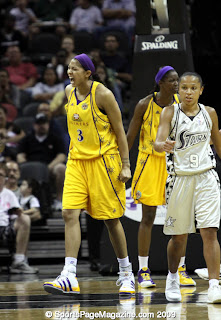
After the Los Angeles Sparks' 67-66 overtime road win over the Silver Stars last night, San Antonio forward Sophia Young perfectly articulated why this was the one game I was looking forward to seeing all week.

"With LA we expect anything,'' said Young. "It's always going to be a good game. They never blow us out, we never blow them out, and it's always an exciting game for the fans.''

Too bad nobody could see it on WNBA LiveAccess...because there's more than one reason to want to watch the Sparks.

Consistent with Young's statement, this was a tightly contested game, perhaps even an ugly one. Looking at the Four Factors statistics, the only major thing separating the two teams last night was the Sparks' dominance on the offensive boards, which is typical of when these teams play.

Combined with the San Antonio Silver Stars' uncharacteristically low assisted field goal percentage -- meaning they were not moving the ball well -- the Sparks got enough of an edge to pull this one out.

However, what makes the game more significant is that it marks a major turning point for the Sparks season -- the night when they became a legit playoff team. Not just because the Sparks moved into third place in the Western Conference after an abysmal start to their season, but also because of how they did it.

The Sparks beat the defending Western Conference champion Silver Stars in San Antonio in a (seemingly) gritty overtime battle to extend a 3 game winning streak to 4.

That’s the type of game hungry and serious playoff contenders win, not only because they have to fight for playoff position, but just to prove to everyone else that they are a team to beat. It forces us to shift our thinking about the Sparks from wondering about what has transpired thus far this season to wondering what might come to pass in the post-season.

And that’s what makes this most significant to me and the reason why I’ve taken an increasing interest in the Sparks since the All-Star break.

Los Angeles fans shouldn’t be the only celebrating the Sparks transition into a legit playoff team. The Sparks are in the midst of constructing what could become one of the league’s great narratives…and that’s good for anyone who cares about the health of the WNBA.

Having center Lisa Leslie make a deep playoff run in her final season and Parker emerging as a real post-season performer after all the mess of a season this has been for them so far really is a great story that sports fans should be able to step into.

Leslie and Parker are arguably the two most prominent women’s basketball players in the U.S. Dramatizing the transition from one to the other with a successful final run for Leslie is exactly the jolt the league needs.

Given the narrative of this season – maternity leave, injuries, inconsistent rotations – having those two at the center of a successful turnaround also creates a hero narrative for the WNBA that is so rarely applied to women’s team sports. It gives people reasons to continue following.

Part of what attracts people to pro sports are hero narratives – people we can root for and who accomplish things that we can only imagine. People who can overcome adversity when everyone has counted them out and persevere to reach the top of their craft.

We can talk all we want about how basketball is a team game and that's what makes it beautiful, but let's be real: it's individual figures like Los Angeles Lakers legend Magic Johnson that make leagues successful.

I’m not saying I am rooting for the Sparks to win it all. But it’s hard to deny that every step closer they get to the WNBA Finals from this point on will be good for the WNBA.

Continue reading...

Storm Reach Out to NCAA Season Ticket Holders: Do NCAA Fans Fit the Profile of Potential WNBA Fans?

.
Make a comment!

There are plenty of creative ways to expand the WNBA's fan base and most recently, we've seen efforts to "convert" NBA fans.

Getting NBA writers to games is one way to create positive press through someone considered a "credible source" to NBA fans.

Mercury blogger Ben York has challenged a hater to watch a live game and actually base their opinion on evidence rather than spurious assumptions.

But I saw a different strategy yesterday while clicking around the University of Washington website to check out their women's basketball schedule: why not tap into local university season ticket holders?

Women's basketball season ticket holders are invited to attend a meet and greet session with Husky head coach Tia Jackson and members of the 2009-10 women's basketball team, and attend the Seattle Storm vs. Connecticut Sun game at Key Arena on August 27.
I don't know whether this has been done before at UW or elsewhere. And perhaps UW is in a unique position to do this well because head coach Tia Jackson is a former WNBA player coaching a team in a WNBA city.

Nevertheless, it's an interesting idea.

NCAA women's season ticket holders likely don't have the same biases as NBA fans or outright haters. And they might enjoy watching the "best of the best" compete as an extension of a sport they already follow.

But most of all, you know they're willing to spend money on women's basketball, which makes them particularly attractive as potential fans.

Of course, I know that college and professional basketball don't mix for everyone -- I know plenty of fans who like one and disdain the other. (Update: Clay Kallam has written about this problem as part of larger phenomenon of "Our Girls Syndrome".)

But if the goal is to expand a fan base, this seems to be a strategy worth pursuing more aggressively, even if the assumption is that this demographic of NCAA season ticket holders have already consciously chosen to either follow the WNBA or ignore it. In the event they have not been to a game, it might be a good way to tap into a group of people who you know are willing to pay to watch women's basketball.

I am planning on being at that August 27th game with two UW students...so maybe I'll check out Jackson's meet and greet before I fixate on comparing Storm point guard Sue Bird and Connecticut Sun point guard Lindsay Whalen. And maybe, we'll come away wanting to check out a UW game as well.

(Extended) side note: I took a look at season tickets for UW women's and men's basketball, which are both reasonably priced, I think. The men's team figures to be better than the women's (again), but I want to give women's NCAA basketball a shot this season. But wouldn't it be cool if you could get some sort of discounted package deal for getting both? Wouldn't that be another interesting way of attracting fans to the NCAA women's game?

Continue reading...

Storm + Mercury + Key Arena = The Perfect Way to Market the WNBA to NBA Fans

. Wednesday, August 5, 2009
Make a comment!

When Bethlehem Shoals of FreeDarko.com (a blog about the NBA, but not merely about basketball) asked me to recommend a Seattle Storm game for us to go to, the choice seemed obvious.

“The best game for a NBA fan to see will be the Mercury on Aug 4 or Aug 21,” I wrote back.

The Mercury feature two of the top candidates for WNBA MVP in Phoenix wing players Diana Taurasi and Cappie Pondexter, a high-octane offense that almost any NBA fan would recognize as reminiscent to Phoenix’s NBA counterpart, and as Mechelle Voepel wrote last month, Storm vs. Mercury just has that panache”.

And last night's game certainly did not disappoint. Nor did the Key Arena atmosphere.

Although the Storm lost to the Phoenix Mercury in overtime 101-90, the game featured heroics from Storm point guard Sue Bird (again) at the end of regulation, a Taurasi-like performance from Taurasi, and Storm guard Tanisha Wright torching the Mercury for 21 in the first half en route to a career-high 25 points.

And oh yeah, Bill Russell was there too…and even more importantly, a Storm Trooper tried to step onto the court after a particularly bad call from the ref in the second half.

However, I spent most of the game talking to Shoals and another male friend, who I shall call Rudy (yes, the basketball version). Neither of them had ever been to a Storm game and both had expressed interest in going at various times this summer.

All three of us fit that 18-35 year old male demographic and I’ve spent quite a bit of time watching both NBA and NCAA men’s basketball with them at various times. I would consider both informed NBA fans that appreciate professional basketball as a sport as much as for its entertainment value. Rudy is a New York Knicks fan who I’ve watched, played, and talked basketball with for about four years now. We have all attended graduate school and are overeducated to different degrees.

These guys aren’t the “average lunkhead male” – they appreciate the game of basketball and have the ability to formulate sentences without grunting and demeaning women.

So long story short – they both enjoyed the game (in different ways perhaps) and said they would like to come back.

During the game we had one of those running conversations full of tangents, non-sequiturs, and worm holes, talking about the league, making comparisons to the NBA, and talking about Bill Russell. And there were elements of our conversation during the game that I found interesting in the context of my ongoing interest in how the WNBA could market to male NBA fans.

So to help answer the question, how can the WNBA market the game to male fans?, I ask another question:

What sort of first impression(s) might the WNBA make on (over)educated male NBA fans?

The crossover worm hole

Shoals met Rudy and I on the east side of Key Arena and immediately tossed me into one of his warped worm holes. A tweet sums up the issue nicely:

"Talking with @kpelton about who has the best crossover-as-fake, not just handle, in the league. I vote Wade, he suggests Rose. Et toi?", he tweeted.

Good lord.

If you knew me, you would know that I was not actually annoyed at the question because it’s stupid or somehow insignificant. The question was annoying because I couldn’t stop thinking about it.

Shoals and I had been to the Adonai Hood Classic on Sunday as well and we talked about the issue there while watching Jamal Crawford. But as we started to come up with answers at the Storm game it became clear that the answer changed depending on any number of other variables that influence a player's decision to make a crossover.

Anyway...Pelton had apparently suggested that Cappie Pondexter had among the best crossovers in the WNBA and I agreed. So in addition to mentally running through every different variant of the “crossover” that I could imagine, I began the game paying close attention to Pondexter’s crossover. And of course, with Wright’s phenomenal first half performance, her ability to get to the basket with her crossover also became a part of the conversation.

But even though I’ve watched Pondexter play quite a bit, she never ceases to impress – as I told Shoals and Rudy, she is a triple-double threat almost every night. And her crossover is a major part of that.

She not only has arguably the best crossover in the WNBA, but also uses it extremely effectively in a number of different ways – on the fast break to get by whoever is standing in between her and the basket, in the half court to gain separation for whichever type of jumper she feels like punishing her defender with at the moment, or simply to penetrate to the basket to set up another player for a scoring opportunity.

Pondexter didn’t actually have a stellar game – going 6-19 from the field – but she also grabbed 8 boards and recorded 5 assists, at least backing up claim that she’s a triple-double threat.

Making NBA comparisons

At various points during the game we attempted to make comparisons to NBA players, since their frame of reference is the NBA. I normally hate doing that (because really it does a disservice to all sides), but since Rudy kept coming up with them, I rolled with it and it ends up being a good way to familiarize oneself with the game.

For example, we decided that Storm forward Lauren Jackson was like the Dallas Mavericks’ Dirk Nowitzki with the heart to play inside, Storm forward Swin Cash like the Oklahoma City Thunder’s Jeff Green with a better perimeter game, and DeWanna Bonner like Golden State Warriors forward Brandan Wright (not necessarily in terms of style play, but skinniness). Rudy at one point suggested that Storm guard Tanisha Wright is like the Utah Jazz’s Deron Williams, but I rejected that.

However, what’s interesting is that Pondexter – and Taurasi – seemed to defy comparison. Which is actually an interesting insight because it suggests that the WNBA actually adds something to the basketball universe. Imagine that?

WNBA player versatility

Skills seem to be much more evenly distributed across positions in the WNBA than the NBA, meaning you don’t have post players who have no skill other than being tall and dunking. On the perimeter, multiple players are able to initiate the offense.

And as Shoals mentioned later via email, “a bunch of versatile skilled players is the NBA's wet dream.”

Shoals was alarmed by the fact that 6’5” forward Lauren Jackson was hovering around the three point line and that guards Sue Bird and Tanisha Wright seemed to be splitting the responsibility of initiating the offense. Part of the reason why Rudy made the comparison of Wright to Utah’s point guard Deron Williams is that Wright almost appeared to be the point guard at times because she had the ball in her hands so often.

Taurasi was leading fast breaks, shooting threes, aggressively trying to block shots, and occasionally running the offense. Mercury center Tangela Smith was 4-6 from three point range and Storm center Camille Little hit a three to tie the game at 81 with 44.7 seconds left in regulation. I mentioned that if they watched a team like the Detroit Shock – who really don’t have a traditional distributing point guard – they might have been even more confused.

Shoals is a fan of versatile players and the blurring of positions that seemed to be occurring on both teams actually seemed to be one of the more exciting elements of the game to him. It makes basketball much more fluid and actually makes offenses much more interesting to watch, if you know anything about x’s and o’s.

Yes, males of the lunkhead persuasion will complain about missed layups and lack of dunks, but as Shoals pointed out, overall, few missed shots are actually bad shot attempts. Because there are so many versatile players who can move the ball and find different ways to score, the scoring opportunities created are pretty solid.

This is basketball in which style does not take precedent over substance, but the substantive abilities of the players give the game a style that the NBA aspires to (a “wet dream”)…or once had.

The WNBA as throwback game

It was interesting that Bill Russell was in the crowd because at multiple times throughout the game, Shoals mentioned how the game reminded him of the type of basketball you see in old footage of NBA basketball in the sixties.

“Weird Russell was there, that game reminded me of sixties ball,” he tweeted at one point.

For the uninformed, that is not a slight of the WNBA game – for someone who appreciates the sport of basketball, it’s a complement. In fact, both he and Rudy commented that given the choice between the WNBA and men’s NCAA basketball, they would probably watch a WNBA game. Shoals was quite adamant about this and I’ll leave him to explain that at some other point.

When you have versatile players and offenses predicated on passing and cutting without dunking, you don’t get worse basketball, you get sixties NBA basketball. Shoals noted at one point that even the post players get their points by cutting and being in the right position rather than on the two man isolation game that tends to dominate the NBA. Personally, as someone who appreciates ball movement and fluidity in basketball, that makes the WNBA one of the most appealing syles of play.

Framed in that way, it’s no wonder that someone like Bill Russell “is on record as being a big fan of the WNBA's style of play” as Kevin Pelton noted during the game on his live blog. As Bob Ryan alluded to in his article, “The Game You’re Missing” last year, if you actually know anything about basketball, you almost have to appreciate WNBA basketball.

If you don’t appreciate basketball, just say it… but don’t disrespect a game you know nothing about.

Engrossed to the point of standing during timeouts

In between all of our meta-analysis of basketball as a phenomenon, we did actually pay attention to the game.

Key Arena – and other arenas around the league – have a ritual of standing until the home team makes its first basket.

Rudy liked this – it seemed to add to the collective atmosphere when everyone sat down at the same time after the first shot. Shoals, who nobody could describe as a “joiner”, was initially less enthusiastic, grumbling when I implored him to stand up at the beginning of the game.

However, in overtime, as Shoals and I were standing and chatting about something or other, he stopped mid-sentence and said, “Wait – do we have to stand during timeouts too?”

Why we were standing during a timeout like dunces is beyond me… but that’s beside the point.

The point here is that the game was engaging in a way that just sort of grabs you and forces you to get caught up. Part of that is a direct result of being in Key Arena – it’s just an amazing basketball venue and when the crowd gets going, it’s difficult not to find yourself caught up in a wave of Storm fanaticism.

But a major part of it is that this is just good basketball and true fans of the sport would find a hard time not getting swept up in it.

The other side of the 18-35 year old demographic

Petrel of the Pleasant Dreams blog emailed me yesterday in response to my post about WNBA marketing and reminded me that there really is no monolithic 18-35 year old male demographic. Within that demographic there are people who are non-sports fans or sports fans who are not moved by the idiocy of shock jock sports radio. But more importantly, there might also be a cross-section of that demographic who is able to appreciate the WNBA game simply because it’s good basketball.

The unfortunate reality is that precision ball movement, cutting, and versatility – the strengths of the WNBA game – are simply not conducive to the short attention span clips of Sportscenter that people have become so accustomed to. To appreciate the WNBA, you can’t expect to be wowed by a highlight reel dunk; to appreciate the WNBA, you have to learn to appreciate the nuance of basketball.

And the best way to do that is probably to show up to a game.

Transition Points:

Thanks to Patrick from the Chasing the Title blog for providing us with these tickets.

Part of Shoals’ infatuation with Bill Russell stems from his interest in having Russel write the intro to his next FreeDarko book, which he is currently doing research for. He’s spent quite a bit reading about the man. Rudy actually went over to Russell and shook his hand, but apparently got no real response from the legend. Just one of millions of hands shaken.

In an attempt to stop over-analyzing basketball, I missed most of the halftime show to go grab a beer. However, Shoals’ girlfriend who was with us, thought the dogs during the halftime show were among the best part of the Key Arena experience.

It’s hard not to admire Tanisha Wright’s game and Patrick Sheehy has a great article on SPMSportsPage profiling Wright. Definitely worth a read. Although I’ve often focused on her offensive abilities, Sheehy does a good job articulating her impact on the defensive end.

I also watched the Los Angeles Sparks’ loss to the San Antonio Silver Stars earlier in the day, a matchup between the Storm’s two previous opponents. Would those games – a triple-overtime win against the Sparks and an overtime win against the Silver Stars – be as effective in swaying NBA fans? I’m not sure… the Mercury’s high-octane style of play is really perfect to entice new fans…we’ll see what Shoals thinks of future games. By the way, down two with four Olympic caliber post players on the floor, why do you settle for a jumper from point guard Kristi Harrower and a three from a frigid cold Tina Thompson…I don’t get it.

Storm Troopers need to remain a prominent part of the Key Arena atmosphere. Here's why: Shoals commented at one point that the refereeing in the WNBA seems to be less invasive than that of the NBA game, making the point that there aren’t quite as many stoppages of play…but I think that was more a function of the Mercury’s style of play. For the most part, their calls were inexplicable. While I don’t complain about the refs often because they make consistently inexplicable calls against both teams, I thought it would have been plenty appropriate for a squad of Storm Troopers to rush the court, capture the refs, and detain them until further notice.


Continue reading...

“Getting Around Gender”: Would the WNBA Benefit From Getting “Out of the Ghetto of Being a Role Model for Girls?”

. Tuesday, August 4, 2009
Make a comment!

I follow women's basketball for one very simple reason:

I love basketball.

The cultural significance of supporting a women's professional sports league is icing on the cake for me.

Summer is the NBA off-season and the WNBA is a perfect counter-balance to keep me fully engaged in basketball for the entire calendar year, schedule permitting.

So I realize that marketing the WNBA to someone like me is simple -- the very idea of extra basketball was enough to get me interested in the WNBA in 1997. The combination of Candace Parker and gloomy Expect Great ads was enough to get me re-invested in the WNBA last summer after taking a long hiatus (moving to cities without WNBA teams).

However, I also realize that most people don't feel the same way about basketball as I do (they might actually have lives). In fact, some people seem to harbor resentment not only for women's basketball, but also that whole gender equity agenda thing that some people still believe is reserved for radical man-hating feminists.

So the very idea of a male women's sports fan is laughable to many people. Sadly, some individuals seem to enjoy going out of their way to demean female athletes and dismiss women's sports as irrelevant. And while I strongly believe that everybody is entitled to their own (defensible) opinion, openly disrespecting individuals who are performing at the top of their profession is just unnecessary.

So when I saw a link to an article on the Soccer Science blog entitled, “One Man’s Struggles With WPS Fandom: Does Liking Women’s Soccer Make You Gayer?” I was at once intrigued and wary of yet another insecure sexist rant.

Of course, I clicked.

Not that I’m afraid of becoming “gayer” by liking women’s basketball (because the very notion of that is ridiculous, as I believe the author intended to highlight). But I was very interested to see how the author – Cyrus Philbrick -- would go about developing his argument. He clearly was not dismissing women’s sports -- he was just trying to express why he’s struggling with it. That’s fair.

The premise of the article is as follows:

I love soccer. And I’m pretty sure I love women. So why don’t I love Women’s Professional Soccer? Or do I, secretly? These are questions I fear to answer because any serious soul-searching might uncover the misogynistic pig within. That, or I’ll end up stripping away a vestigial layer of macho-callous that has kept me straight and largely insensitive to the needs of women through the years. Oh well, here goes…
The article is actually a pretty fair description of some of the challenges that some men might have in making the transition from men’s sport to women’s sport.

However, Philbrick does not merely rehash standard critiques. In fact, he makes a critique that I normally take for granted in all my fervor about the cultural significance of women's sports.

His post ultimately arrives at the conclusion that WPS athletes are marketed as role models for girls, something that may alienate male fans. Which begs the question -- what about the WNBA?
“We need to get out of the ghetto of being a role model for girls,” Andy Crossley, the Boston Breakers’ director of business development, said in a recent New York Times article. “You can’t make dads feel like they’re visiting Chuck E. Cheese’s.”

The problem is I’m not sure if anyone knows how the league can change this. WPS works best as an inspiring example for young girl players. And as millions of them exist in this country, this isn’t a bad selling point. But to draw in the rest of us skeptics remains a challenge that will take a lot more than just innovative social media marketing.
I find this to be an interesting argument.

My knee jerk reaction is that perhaps these dads who feel apprehensive about doing things with their daughters because of how they feel need to get over themselves. But... you know... since I’m not a father…I’m going to suspend that judgment.

So beyond personal hang-ups, I suppose I don’t see being a role model for girls as a “ghetto” to begin with.

Isn’t being a role model for girls a good thing? Isn’t promoting fitness and sport for girls a good thing? And, most importantly, isn’t it somewhat inevitable that female athletes will be role models, given that women’s professional sports are a relatively new (and sometimes contentious) phenomenon?

But for a moment, let’s assume that getting out of the ghetto would indeed help the WNBA…then what? Where exactly would a league like the WNBA go from there?

“Marketing Women’s Sports to Men”

These questions led me to another article on a blog about marketing to women entitled, “Marketing Women’s Sports to Men”. The author – Andrea -- says the following, looking specifically at how NASCAR and figure skating have attempted to transcend gender in their marketing strategies:
Now, the sports realm, overall, has come full circle in the ways that previously pegged “women’s” sports must grow to reach more men.

And, how are they going to do that? By identifying what about the particular sport appeals to a men’s market and highlighting that. If the marketing decision-makers are smart, they’ll likely figure out a way to do so without alienating the women who already love said sport. Now, to clarify: It isn’t necessarily men that the more female-fan skewing sports should be worrying about. Instead, those marketing decision-makers should spend time learning to reach all of the human beings who appreciate the (traditionally) more masculine aspects of the sport.
The suggestion in this article is the de-genderfication of sport – finding the elements of a sport that appeal to all fans and highlight them.

However, given differences in the way men and women play basketball (see "Transition Points" below), “highlighting the masculine aspects” of basketball is almost impossible for the WNBA – at this moment, there is no female athletic equivalent of athletes like LeBron James or Dwight Howard. And part of what people like about the NBA is the almost surreal feats of athleticism. Women’s basketball can’t really provide those particular athletic aspects of the game, that have become prominent.

So if the WNBA is somewhat immune to de-genderfication, what else might a marketing expert suggest?

How about an awareness of third wave feminism, as Andrea suggests in another post?
I’m not saying that all is perfect between men and women now. I’m suggesting it might be a good time to accept that there is no easy answer but to study up on how the women in your market fit into this wave (or not). They might consider themselves feminists, but that could be VERY different from your mother’s feminism. And, today, there may well be a lot more men who consider themselves feminist or identify with the movement (whether they say so or not), and by making assumptions, you could potentially lose trust with them as well, Remember, too - parenthood tends to put most guys into a gender transcending role that changes their behavior in other ways. So, feminism can just creep up on you (in a good way)!

An awareness of third wave feminism is not for women’s studies majors only. Instead, it is a movement that may offer up the insights you need on how/why your consumers live and make decisions the way they do.
If we take Andrea’s posts together, then the challenge for a sport like the WNBA is finding a way to minimize the gendered elements of the sport (that may in fact define it) while simultaneously drawing upon insights from third wave feminism to understand what women might want beyond the antiquated narratives of equal opportunity and representation.

But...

While I understand all these points about ghettoizing women’s sports, de-genderfication, and taking an expansive approach to feminism (that includes men rather than assuming it’s a “women’s only” domain), I also find the approach highly problematic.

Girls still need role models…just like boys have had for decades/centuries/The Big Bang or Genesis. And it's worth playing that up.

There are gender differences in athletics that we should probably learn to appreciate instead of disregarding or rejecting them outright. And it's worth helping people do that.

And while feminism is not only for women’s studies majors and should apply to men, it also seems dangerous for it to become a part of a marketing strategy. Not that the feminist principles would necessarily lose their edge if assimilated as part of a marketing strategy…but…things tend to lose their edge when they are assimilated as part of a marketing strategy.

Nevertheless, the sad fact is that these commentaries may be right – indeed, it may simply not be profitable to market women’s sports as “political”, whether it be in a role modeling capacity, the symbolic promotion of equal opportunity/representation, or a direct challenge to sexist attitudes.

So where does this leave us?

The tension here is that if men want to demean or dismiss women’s sports for being too “Chuck-E-Cheese”, “too feminine”, or “too feminist”, I firmly believe that is their problem, not the problem of women’s professional sports.

But realistically, the market for sports is traditionally the 18-35 male crowd, which is stereotypically proud of being against things labeled as “Chuck-E-Cheese”, feminine, or feminist. And there are certain women (that I’m sure we could all think of and name) who hold the same views.

However, what is most troubling to me is the assumption underlying all of these things: sexism exists and if women’s sports are to be marketable, they have to roll with it rather than going against the grain.

Realistically, most people can’t be bothered with political messages about role models, opportunity, or oppression/discrimination/prejudice while they’re being entertained. They merely want to be entertained.

So that leaves us with the question of where are the people who want to be entertained by women’s basketball? And how does the WNBA reach them?

Does the WNBA need to “Get Around Gender”?

Well, take this insight from another Andrea’s posts entitled, “Getting Around Gender”:
An article in the latest issue of Pink mentioned how the Ross School of Business at the University of Michigan got creative in reaching out to women, specifically for their executive MBA programs. Because state law prohibited the school from offering gender-based scholarships, they did the research and realized that a lot of non-profit executives happened to be female. So, Ross focused its scholarship money there. Brilliant. The school figured out a commonality that had nothing to do with gender - and learned how to reach THAT group effectively… My point is that, in a lot of cases, the best marketing to women has gotten around the gender question by serving humans/individuals who may so happen to be women.
In other words, if somebody stepped in and told the WNBA they could not market exclusively to women, what might they do? How might they describe their consumers aside from gender (or sexuality) identifiers?

Does the target audience like particular elements of the in-game experience? Do they like certain player personalities? Is it a particular style of play that a change in rules could really accentuate?

The notion of gender-blindness is problematic, if not downright harmful to me. But that is essentially what this blog is suggesting: gender-blind marketing. And yet, if gender is toxic to sports profit as all these people are suggesting, then maybe that is the strategy… but would a gender blind marketing approach even work for a league that is absolutely gendered?

Hmmmm…

I must fully acknowledge that Andrea is not talking about the WNBA -- she made a reference to NASCAR and figure skating and I'm trying to make a link to the WNBA....

Ultimately, I don't think such an approach would actually draw the fans who have blatantly sexist and dehumanizing reasons for not watching women's sports to begin with. So hiding from such an obvious aspect of the league -- that the women are role models -- just seems counterproductive.

It is important that women's sports leagues exist, if for no other reason "to get females to play" as Mechelle Voepel wrote about on Sunday. But while that is great advocacy for a women's non-profit organization, is it viable for a professional sports league striving to make profit?

But is it so difficult to imagine a world in which people stop judging women by men’s standards and are actually genuinely entertained by female athletes? Is there no way to appreciate women for their athletic feats just as we appreciate men? Why can’t we strive for a higher human standard rather than striving for the lowest consumer denominator?

Naïve, idealistic questions…that I find worth wondering about…

Relevant Links:

When it’s ‘her’ turn to just dive right in (Mechelle Voepel)
http://voepel.wordpress.com/2009/08/02/when-its-her-turn-to-just-dive-right-in/

Marketing Women's Sports to Men
http://learnedonwomen.com/2009/04/marketing-womens-sports-to-men/

Getting Around Gender in Marketing
http://learnedonwomen.com/2009/07/getting-around-gender/


Transition Points:

The argument that first stuck out to me in Philbrick's piece
was the one about the speed of women’s soccer – that “It’s inarguably, frustratingly, heart-murmeringly slow.” Ouch. However, one could certainly make the same argument about the WNBA in comparison to men’s basketball…and that of course led me down a much longer path…

This past weekend I probably spent way too much time watching basketball. On Saturday I went to see the Seattle Storm defeat the San Antonio Silver Stars in overtime. Then on Sunday I went to see NBA players with Seattle ties play in the Adonai Hood Tournament, a four-team tournament of local high school alumni. And as I probably need not tell you, the differences between the women’s and men’s game were quite stark.

The men’s game is just faster, more physical, and yes, field goal percentages are typically higher. And for a game that is predicated on putting a ball into a ten foot high hole, the fact that men are taller on average is significant.

The fact is that the women’s game simply does not have athletes like the 5’9” Nate Robinson (NBA player from Seattle’s Rainier Beach High School and University of Washington) – an ultra-quick former NCAA Division I football defensive back who has won two NBA Dunk Contests, including this year’s in which he jumped over the 6’11” Dwight Howard for a dunk (in 2006 he jumped over another diminutive dunk champion, former NBA player Spud Webb).


Taking Robinson as one example of the type of athleticism in the NBA, these games are just different. And as I’ve said before, if you are going to support women’s sports, you first have to accept that they are different from men’s sports (duh…right?) and just appreciate each on their own terms, loving the sport as a sport as well as another form of entertainment.

Tonight: Storm game with a NBA fan who has never been. Should be fun...

(Note: I’m still not entirely sure how watching women’s sports – or anything for that matter -- might make one “gayer”, though many men seem to feel their sexuality is at stake when watching women’s sports. If I was hypothetically operating on such lunkhead male “logic”, it would seem that the opposite would be true – that spending hours watching sweaty men post each other up and pat each other on their firm behinds would make me “gayer”)

Continue reading...

President Obama Describes Why "Money Isn't Everything": How the WNBA Represents an Opportunity to "Release the Imagination"

. Monday, July 27, 2009
Make a comment!

When President Barack Obama honored the 2008 WNBA champion Detroit Shock today, he once again took the opportunity to mention what the league means to his daughters.

Let me also say something as a father -- I was mentioning it to the team before we came out. It's hard to believe the WNBA has already been around for 12 years. And that means that my daughters have never known a time when women couldn't play professional sports.

They look at the TV and they see me watching SportsCenter and they see young women who look like them on the screen. And that lets them and all our young women, as well as young men know that we should take for granted that women are going to thrive and excel as athletes. And it makes my daughters look at themselves differently; to see that they can be champions, too.

So, as a father, I want to say thank you.


These remarks may strike you as a mundane repetition of the comments he made back in April while congratulating the University of Connecticut championship women’s basketball team.

But it never gets old to me.

Although Obama’s agenda for gender equity may not please everyone, the message he’s sending about the value of female role models is an important one and is worthy of repetition as long as we continue to live in a society with deep gender disparities. What makes Obama’s remarks assume even greater importance is that his daughters are young black girls and the dearth of positive black female role models in the mainstream makes the existence of the WNBA even more important.

Although images of positive black female role models in the mainstream have certainly evolved beyond Oprah and Clair Huxtable – including First Lady Michelle Obama – I would argue that our society could do more to support the dreams and aspirations of black girls. That starts with thinking about how black women are represented in the media.

Unfortunately, mere representation is not enough – it is just as important to consider how black women are represented in the mainstream media (the central dilemma in the controversy surrounding Candace Parker’s ESPN the Magazine cover story). Close scrutiny of how black women are represented in the mainstream media reveals more than mere coincidence or arbitrary action, but a pattern of conscious editorial decision-making that becomes rather troubling in the aggregate.

The fact is that the way in which WNBA women are represented is only one piece of a much larger pattern of decision making that not only includes decisions about representation, but omission. And the invisibilizing of black women often reflects a much more troubling underlying assumption – that black women are not marketable.

If we accept the assumption that black women are not marketable, it seems almost irresponsible not to ask a) why?, b) what are the consequences of that assumption, and c) to what extent are the editorial decisions themselves responsible for perpetuating the problem? Ultimately, the answers to that line of questioning only reinforce the point Chantelle Anderson made in her most recent blog post: Money Isn’t Everything.

The violence of omission

As an example of how these editorial decisions operate beyond sports, Australian young adult literature author and WNBA fan Justine Larbalestier recently blogged about her publisher’s decision to use a cover image of a white girl to represent a black female protagonist for her recent book Liar. Larbalestier points out in her blog that she envisioned the protagonist looking something like Washington Mystics All-Star guard Alana Beard.

Larbalestier’s entire post (click here) is worth a read, but this excerpt seems relevant to the present discussion:
Every year at every publishing house, intentionally and unintentionally, there are white-washed covers. Since I’ve told publishing friends how upset I am with my Liar cover, I have been hearing anecdotes from every single house about how hard it is to push through covers with people of colour on them. Editors have told me that their sales departments say black covers don’t sell. Sales reps have told me that many of their accounts won’t take books with black covers. Booksellers have told me that they can’t give away YAs with black covers. Authors have told me that their books with black covers are frequently not shelved in the same part of the library as other YA—they’re exiled to the Urban Fiction section—and many bookshops simply don’t stock them at all. How welcome is a black teen going to feel in the YA section when all the covers are white? Why would she pick up Liar when it has a cover that so explicitly excludes her?

The notion that “black books” don’t sell is pervasive at every level of publishing. Yet I have found few examples of books with a person of colour on the cover that have had the full weight of a publishing house behind them. Until that happens more often we can’t know if it’s true that white people won’t buy books about people of colour. All we can say is that poorly publicised books with “black covers” don’t sell. The same is usually true of poorly publicised books with “white covers.”
While these editorial decisions may seem distant from sports, consider the consequences of this whitewashing of young adult literature – it not only sends messages of who/what is valued in our society, but also presents a completely skewed version of what our world looks like. Compounding the problem is that publishers, libraries, and bookstores, are actively making decisions that set these books up to fail…which thus reinforces their belief that the books are worth publicizing.

The same goes for women’s professional sports, and particularly the WNBA with it’s large percentage of black women: it is paradoxical to not market something – or even deliberately hide it – and then standby the claim that it’s not worth marketing because it’s not marketable.

While this phenomenon should not come as a surprise, it is troubling to think that we live in a society that deliberately prioritizes profit over the humanity of our youth.

What I love about Chantelle Anderson’s recent blog post is that it captures what is humanly at stake in having mainstream representations of black women that serve as role models. The value of honoring the humanity of our young black girls extends well beyond commodification, marketability, and profit margins toward something seemingly more fundamental to what makes us all human.

Anderson’s articulation of why the WNBA is valuable is a perfect example of why all this talk of representation and role models really matters.

To summarize, Anderson tells a story about a high school girl whom she met after a speaking engagement who was involved in gang activity and had recently quit her basketball team. The coach asked Anderson to talk to the sophomore and presumably convince her to return to the basketball team. Anderson not only inspired the girl to decrease her involvement with the gang, but also help her get to college on a Division I scholarship. Anderson nicely explains the value of WNBA role models in her concluding paragraphs:
I met Tamika when she was a sophomore in high school. As of now, she just finished her freshman year at a Division one university, which she attended on a full ride basketball scholarship. To say that I am proud of her would be an understatement. To say that I believe God used my position as a professional athlete to help save this girls life would be the truth. We hear countless stories about the NBA players that used basketball as a ticket out of the dangerous neighborhoods and broken homes of their childhood. But what about the little girls left in those neighborhoods? Don’t they deserve a chance too?

This was not meant to be some sentimental plea to keep the WNBA alive or garner fan support. It was meant to show that even if countless men don’t value it, professional women’s sports do and should have a place in our society. This story is not a fluke or an isolated incident. Stuff like this happens regularly to myself and other WNBA players; and not just involving kids. I’ve had women tell me watching how hard I work in my workouts helped keep them coming to the gym and eating healthy. And I’ve had men tell me they use me as an example to encourage their daughters to dream. These compliments are such an honor to me; way better than being told I’m pretty, or even smart. But I would hate to turn around and tell those people that none of what they feel deserves validation because women’s basketball doesn’t make enough money. That’s why the WNBA is important.
There’s a lot going on in Anderson’s story, but as an educator and someone interested in the welfare of youth, I want to bring it back to this notion of what it means to honor the humanity of youth.

While removing oneself from gang activity and going to college is an important accomplishment, I would argue that the even more valuable aspect of this scenario is that Anderson helped Tamika see alternative possibilities for herself beyond what the limited perspective she saw in daily life. That capacity to imagine an alternative vision for oneself and act upon the world with that vision in mind is what makes all this talk of representations and role models so important.

Releasing the imagination of young black girls is of the utmost importance.

Educational philosopher, social activist, and teacher Maxine Greene has written extensively about the topic of imagination and I think she can provide some additional insight to the value of thinking more deeply about the value of the WNBA both in terms of representations of black women and mentoring relationships, such as Anderson’s.

First, the reason that these mainstream representations are important to reflect upon is not just a matter of self-esteem, but more a matter of future orientation and self-concept: encouraging young girls to imagine multiple possibilities for society and letting them know they have support in those endeavors. When we as a society make decisions not to help scaffold that imagination with multiple representations of what could be (e.g. deciding black women are not marketable and thus not worthy of representation in young adult literature), we leave the possibility of positive self-concept and self-determination to chance.

In her book Releasing the Imagination, Greene writes the following about this problem:
Far too seldom are such young people looked upon as beings capable of imagining, of choosing, and of acting from their own vantage point on perceived possibility. Instead they are subjected to outside pressures, manipulations, and predictions. The supporting structures that exist are not used to sustain a sense of agency among those they shelter; instead they legitimate treatment, remediation, and control – anything but difference and release.
When I read Anderson’s story about her experience meeting Tamika, that’s what I see – a young girl who without support in imagining the range of future possibilities fell victim to the deceptive pressure of gang activity. After all, gang activity provides everything school and society often doesn’t – a sense of belonging, an identity of agency, and a peer community of mutual support…not to mention additional street cred that many school-based options simply don’t provide.

We are often too quick to condemn youth involved in gangs without attempting to understand the opportunity structure in society that they perceive in front of them. For some, this society does not look like it’s full of opportunity and rhetoric to the contrary is thus all the more alienating.

Imagination,” writes Greene, is therefore “…the gateway through which meanings derived from past experiences find their way into the present.” To elaborate, imagination is an antidote to the inertia of ill-formed common sense that serves to privilege some ways of being at the expense of others.
To tap into the imagination is to become able to break with what is supposedly fixed and finished, objectively and independently real. It is to see beyond that what the imaginer has called normal or “common sensible” and to carve out new orders in experience. Doing so, a person may become freed to glimpse what might be, to form notions of what should be and what is not yet. And the same person may, at the same time, remain in touch with what presumably is.
As President Obama alludes to, the value of the WNBA is not just in inspiring female basketball players or even female athletes more broadly. What it represents is a small departure from a world in which women were once told there were things they cannot do. It lets them know that there is something beyond what some people still espouse as common sense about women’s limitations.

In my ideal world, we would cease asking whether the WNBA or images of black women are profitable in the mainstream and start asking ourselves what the value of either is to society at large. If what it means is a few multi-millionaires lose a couple of bucks here and there for the sake of millions of young girls worldwide, I’ll gladly go along with it.

For black girls in particular – in a world where some people think of their image only in terms of its toxicity to profit – the WNBA provides a glimpse into a world in which there are a range of positive representations of “blackness” and “womanhood” for them to imagine what has not yet come for themselves.

So I don’t begrudge those who don’t want to watch the WNBA. I begrudge those who go out of their way to demean and dismiss it as some sort of irrelevant sideshow.

Understanding the value of women’s professional sports to our young girls shouldn’t require being a father, brother, or husband. Nor should it limited to radical feminists or political leaders trying to establish themselves as advocates of gender equity.

It’s about respecting the humanity of our youth.

Continue reading...

“If the WNBA had the gumption to take a more progressive stand…”

. Tuesday, June 16, 2009
Make a comment!

When I first watched the All American Red Heads video montage that has been floating around WNBA circles, it was hard to ignore the political impact they might have had in addition to the historical legacy of women’s basketball.


For women to not only get paid to play professional basketball, but also show off and outplay men as they were doing it had to be considered radical for the time. From John Molina’s All American Red Heads website:
When the Red Heads set out on the road, they weren't just playing basketball. They were pioneers to break down all of these stereotypes....and didn't even know it at the time. They were just women that had a great passion to play basketball…


They would only play against men and by mens rules. During that time, women were playing 6 on 6 with only 3 players being allowed to cross the court.

There was still much concern at the time, that women shouldn't play the game like a man because they weren't as physical and could hurt their chances to have children.
As Molina implies, even if the Red Heads' players did not consider themselves “activists” or “feminists” but “just passionate athletes”, they were undeniably involved in a highly politicized activity, even if only by challenging stereotypes. And as we know, those stereotypes of gender (or race) have concrete social consequences.

Based upon the type of public statements made about women today, we can probably infer that the concept of women (a) being paid to (b) travel around and play basketball (c) against men (d) with men’s rules and (e) beating them was met with some sort of resistance, if not outright hostility. I would assume that it took quite a bit of courage and strength to even make the decision to participate in such an activity.

As I try to imagine the mainstream response to the Red Heads, I also wonder about their reception by feminist/women’s rights activists of their time – how did representations of women as athletes either fit or deviate from broader feminist agendas of that time?

If movement building is fundamentally about reframing various norms, values, or roles to overcome injustices or social problems, then images of women breaking the stereotypes that perpetuate inequality would seem potentially valuable to a movement.

Even now, in 2009 (*gasp*!!), the repeated statements made about female athletes – specifically those who play “men’s team sports”, like basketball – illustrate that the notion of “female” and “athlete” still creates a measure of cognitive dissonance in the collective consciousness of mainstream society.

So the idea that a women’s professional basketball league is not somehow political strikes me as a complete fiction.

Which means I have to wonder a similar question about the WNBA – how does the league fit or deviate from broader feminist agendas? And if there is a fit, should the league openly embrace those broader agendas?

A former high school sports reporter raised a related issue in the comments of a recent blog on Bitch Magazine. While the story he tells does not necessarily have to be considered a call to action, it’s worth considering as we think about the place of the WNBA in a broader socio-political context.

“…if the WNBA had the gumption to take a more progressive stand toward homosexuality, would it have helped this girl?”

The comment came in response to an article entitled “We Got Lame” in which Bitch Magazine writer Jonanna Widner wrote about how the early marketing of the WNBA turned her off from the game. At the end of the article, she made three recommendations for the WNBA:

1. “embrace the dykes” (referring to fans, not necessarily players)
2. “embrace the rebels”, and
3. “let go of the mommy fetish”

Many of the comments to that post focused on the use of the word “lame” and whether it was appropriate on a feminist website that takes an anti-oppression stance (a subject for another blog post that I believe Widner will address). So Luke, the sports reporter, responded to the article on Widner’s next post about female dunkers:
I covered high school athletics for a community newspaper the past two years, and during this past basketball season there was a scandal on the girls basketball team that absolutely sickened me. To make a long story short, our star player (a dynamite sophomore 5 guard and one of the most exciting athletes in our school, IMO) was forced to quit the team because of a homosexual relationship.

Her own mother forced her to quit two weeks before the end of the season, apparently because someone had seen her kissing another player.

There wee only about 7 girls on the team to start with, and 90% of what the team did was based on feeding her the ball. They lost the last 4-5 straight games of the season, finished outside of the playoffs and cut short a very entertaining season. To make the whole thing worse, she will likely not be allowed to participate in any sport whatsoever next year, since she quit the team before the end of the season.

There is no doubt in my mind that this kid has the potential to be a Division I, perhaps even professional athlete, but it seems as if her own parent's homophobia is going to prevent it. As I was reading your earlier post, I couldn't help but wonder to myself, if the WNBA had the gumption to take a more progressive stand toward homosexuality, would it have helped this girl? Would having openly gay professional athletes featured on television have made her mother more accepting?
First of all, we could easily dismiss Luke's story as trivial; this situation could very easily be reduced to a matter of a family decision outside the reach of a massive corporate sponsored basketball league with a “feminist” agenda. However, I think that’s beside the point.

The point here is that our limited notions of what girls should and could be has significant limiting effects on the daily lives of individuals. It’s not some abstract ranting of a radical feminist who wishes that all men would just drop dead. It’s a matter of honoring the humanity of women.

The WNBA presents an opportunity to contribute to the process of breaking down stereotypes and provide a challenge to dominant culture. And yet the league seems to straddle the fence trying to cram these images of female athletes into the box of existing notions of womanhood rather than challenging the limits of the box altogether.

So Luke’s questions also implicitly beg the broader question of the potential of the WNBA to actively shift the public consciousness around specific feminist agendas. What would it mean for the league to actually serve as a political friend to the girl that Luke describes not just by passively existing, but by actively sending a social justice oriented message?

What is to be done?

The Expect Great campaign is certainly an attempt to challenge dominant narratives. But as has been described ad nausea at this point, the campaign is somewhat ineffective. The problem seems to be that the league wants to challenge the dominant narratives but can’t decide how. Widner opines the following:
This week, the league began its 11th season the same way it has since its first one: In trouble. The league doesn’t make money. Television viewership continues to fade, as does attendance. Several teams have folded. It’s bad—in fact, every season since that first one, the NBA has subsidized the WNBA’s existence, because the latter can’t sustain itself (hmmm…the men supporting the women, because they can’t make it on their own…for all its queerness, I guess there are some things in the league that remain entrenched in hetero tradition). Clearly, the family-oriented marketing, the insistence on tamping down any dyke-ynesss or alternative-ness—these strategies aren’t working.

And yet, still…that insistence continues. The league can’t stop pushing its superstar, Candace Parker (who can dunk too), not because of her strength, smarts, and skills on the court, but because she just had a baby. And the media won’t STFU about it either. Parker landed a coveted “5 Good Minutes” interview spot on the popular ESPN show “Pardon the Interruption” to talk about her baby. How come she didn’t get it when she first dunked in a pro game?

And then there’s this:
http://www.newsday.com/sports/basketball/ny-lsfash1012833678jun08,0,2366...

Yet another fashion spread featuring 6-foot lady ballers from the New York Liberty—the so-called “Glamazons”—couture-clad, posing awkwardly with basketballs.

It’s not working. No one is buying it, WNBA, and you’re bleeding money to boot. You are a laughingstock.

And that makes me so, so sad.
If nobody is buying the current line and those that are will show up regardless, why NOT just embrace a more political orientation?

“But it’s just entertainment!”

Of course, the counter-argument is obvious: if the WNBA promoted itself as an advocate for women instead of “just a bunch of passionate basketball players” there is the risk of losing fans. But do we really believe that?

Who is it exactly that would stop paying attention to the league if it took a specifically political orientation?

I’m not suggesting policy advocacy – the fact is, there is not even agreement among feminists or activists about what policy course should be taken. There is not one singular feminist agenda and the idea that there could be seems profoundly anti-feminist. It doesn’t mean showing up at abortion rallies or choosing a health-care platform for the league to sponsor.

There are of course many different ways to serve as an advocate for women. But I agree with Widner -- athletes concerned with makeup, pushing fashion and talking babies just doesn’t seem to be the way to go and in fact, it may even perpetuate the kind of narrow notion of womanhood that Luke is concerned about.

Furthermore, even if the league doesn’t want to frame itself as a political or “feminist” entity, other people seem to enjoy doing so. Take the following statements from a renowned WNBA critic about the WNBA and recently nominated Justice Sonia Sotomayor (I refuse to link to that person’s site, but you can get the text of the piece from the DailyKos):
I called a spade a spade. I correctly pointed out that Sonia Sotomayor a/k/a So-So a/k/a Sonia From the Block a/k/a Justice J-Lo a/k/a Red Sonia has done nothing remarkable, that she got every single place she got for one reason: that she's a female Latina and got affirmative action for it. That she has the same background and life story as J-Lo a/k/a Jennifer Lopez.
But you can't tell the truth in America. Or, at least, you can't tell it without being attacked and savaged by the left in America. So, predictably, the Nazi-funded Media Matters folks, the reconquista illegal alien schlubs at the National Council of La Raza and their friends at the Washington Post, and the WNBA season ticket holding brush-cutted "women" at various feminist groups are all upset about my truth-telling on Justice J-Lo. They say it's prejudiced. Uh-huh.
The WNBA can try to remain neutral and separate from those “rabid feminists”…but in the end, it can really escape its political identity.

“I finally understand what feminism is about”

Rethinking Basketball was sort of established on the premise that the WNBA is a legitimate lens through which to explore the intersection of pop culture representations and gender inequality in the U.S.

And yes, there have been similar posts about the WNBA and politics in the past on this blog.

Yet, it still seems worthwhile to ponder Luke's questions.

That does not necessarily mean there is one answer, but it does seem like there is value in thinking more deeply about the convergence of gender politics and women’s sport.

In that spirit, a post on the Pleasant Dreams blog responding to a post about criticisms of the WNBA from the “13 Teams, 1 Journey” blog comes to mind.
What I will say is this: after following the WNBA for a year and reading the comments that sportswriters and so called "experts" write about it: I finally understand what feminism was all about. I understood it on an intellectual basis, but never on a visceral one. Jesus, nobody should have to put up with that kind of shit on a daily basis. As men, we should all thank the first women we meet - not because of their contributions to history, but in sheer gratitude to the female gender for not killing every man within 15 miles.
While I may not agree that women have reason to kill every man within 15 miles to begin with, I think petrel’s comment does point out that there is some political value to the WNBA regardless of whether it chooses to embrace it.

Certainly the very existence of pioneering women like the All American Red Heads could be considered vital to the creation of the WNBA. And when you consider the Red Heads and the WNBA as part of an extended progression of women’s professional basketball rather than two distinct phenomena, it seems problematic to claim that the political element of the women’s basketball suddenly fell to the wayside.

So given the political legacy of women’s professional basketball that the WNBA is immersed in, you have to wonder what its political legacy could be. After 70+ years of women playing professional basketball, it would be rather surprising to hear a player claim that she was unaware of the political nature of the activity.

If we assume that a large number of women involved in the WNBA – from players to coaches to league officials – are aware of its political nature, then that begs a follow-up question: should the WNBA take on a more overtly political image? And what influence could a women’s sports league have on broader society if it did take a political stand on issues of concern to women?

Continue reading...

Transition Points: WNBA LiveAccess is Finally Both Live and Accessible

. Friday, June 12, 2009
Make a comment!

So I have finally gotten to watch some games. Which is good.

Just yesterday I got it to work on not only Safari but Firefox as well.

The archived versions of games are of course the smoothest way to watch, but the live stream is also improving.

There's a little bit of a Blair Witch Project effect going occasionally...

But bottom line is this: you cannot be a fan of that which you cannot see.

LiveAccess is therefore a huge leap forward and although fans should hold the WNBA to a higher standard, the WNBA is getting there with limited resources. So kudos.

Will have some thoughts on a few games I watched later.

For now...some other thoughts...

Part 1 of Storm 10th Anniversary Documentary posted

The first part of the 10th Anniversary documentary that the Storm showed on Storm vision at the first Storm home game on Sunday has been posted on the Storm's 10th anniversary website (click here). It's worth a look.

I recall at the game that Lin Dunn got a large round of applause at the game when she first appeared. Which is funny because I think I've seen posts from a Fever fan or two that have not been quite so pleasant...

Kobe: the Mad Mamba

It's been quite an impressive Finals series to watch. Last night's game was one of the better NBA Finals games I've seen in a few years. Kobe Bryant is determined to win a championship without Shaq and get that monkey off his back.

Mike Wise of the Washington Post had a particularly funny characterization of Kobe in this morning's article, "Hey Kobe, Smile! You're Winning":

It's as if he doesn't want to merely defeat Howard and the Magic; he wants to disembowel them.

Once genteel this time of year, friendly even, as he flashed his telegenic grin chatting amiably with whoever crossed his path.

Now the mad Mamba looks like he wants to take your lunch money. Meet you behind the cafeteria. Dunk maliciously on your children.
What I find funny about this is that all the attention is on Kobe and his ability to win without Shaq...but he's doing so with one of the deepest rosters we've seen this decade.

I'm a San Francisco 49ers and it reminds me of how the 1995 Niners helped Steve Young get the Joe Montana monkey off his back by bringing in any Pro Bowl player who would take a pay cut to play for them.

This is not a slight on Bryant or Young -- but I'm not entirely sure what has been proven by replacing Shaq with Pau Gasol, Andrew Bynum, Lamar Odom and Trevor Ariza...plus the veteran clutch savvy of Derek Fisher. So Kobe can win with one All-Star future Hall of Famer (2000-2002) or a bunch of really good players (2009?), but not on a team with three other Hall of Famers (2004)? I'm not really sure this gets a monkey off of his back yet...

Mickael Pietrus' foul on Gasol

Here's one for all those people out there who have quit watching the NBA because it sometimes just becomes a display of hyper-masculine bravado rather than actual basketball:


OK...so recap: did Gasol have to dunk at the end of a game that was already decided and would put the Lakers up 3-1? No. Probably not.

But in what alternate universe is there any justification for Pietrus' actions? Hitting a player in the air and then talking trash? Fouls like that could jeopardize a player's career and even though Gasol landed without getting hurt, Pietrus needs to be suspended for that one.

Continue reading...