The Los Angeles Sparks: "Expect Anything"

. Friday, August 21, 2009
Make a comment!

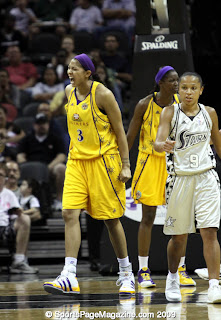
After the Los Angeles Sparks' 67-66 overtime road win over the Silver Stars last night, San Antonio forward Sophia Young perfectly articulated why this was the one game I was looking forward to seeing all week.

"With LA we expect anything,'' said Young. "It's always going to be a good game. They never blow us out, we never blow them out, and it's always an exciting game for the fans.''

Too bad nobody could see it on WNBA LiveAccess...because there's more than one reason to want to watch the Sparks.

Consistent with Young's statement, this was a tightly contested game, perhaps even an ugly one. Looking at the Four Factors statistics, the only major thing separating the two teams last night was the Sparks' dominance on the offensive boards, which is typical of when these teams play.

Combined with the San Antonio Silver Stars' uncharacteristically low assisted field goal percentage -- meaning they were not moving the ball well -- the Sparks got enough of an edge to pull this one out.

However, what makes the game more significant is that it marks a major turning point for the Sparks season -- the night when they became a legit playoff team. Not just because the Sparks moved into third place in the Western Conference after an abysmal start to their season, but also because of how they did it.

The Sparks beat the defending Western Conference champion Silver Stars in San Antonio in a (seemingly) gritty overtime battle to extend a 3 game winning streak to 4.

That’s the type of game hungry and serious playoff contenders win, not only because they have to fight for playoff position, but just to prove to everyone else that they are a team to beat. It forces us to shift our thinking about the Sparks from wondering about what has transpired thus far this season to wondering what might come to pass in the post-season.

And that’s what makes this most significant to me and the reason why I’ve taken an increasing interest in the Sparks since the All-Star break.

Los Angeles fans shouldn’t be the only celebrating the Sparks transition into a legit playoff team. The Sparks are in the midst of constructing what could become one of the league’s great narratives…and that’s good for anyone who cares about the health of the WNBA.

Having center Lisa Leslie make a deep playoff run in her final season and Parker emerging as a real post-season performer after all the mess of a season this has been for them so far really is a great story that sports fans should be able to step into.

Leslie and Parker are arguably the two most prominent women’s basketball players in the U.S. Dramatizing the transition from one to the other with a successful final run for Leslie is exactly the jolt the league needs.

Given the narrative of this season – maternity leave, injuries, inconsistent rotations – having those two at the center of a successful turnaround also creates a hero narrative for the WNBA that is so rarely applied to women’s team sports. It gives people reasons to continue following.

Part of what attracts people to pro sports are hero narratives – people we can root for and who accomplish things that we can only imagine. People who can overcome adversity when everyone has counted them out and persevere to reach the top of their craft.

We can talk all we want about how basketball is a team game and that's what makes it beautiful, but let's be real: it's individual figures like Los Angeles Lakers legend Magic Johnson that make leagues successful.

I’m not saying I am rooting for the Sparks to win it all. But it’s hard to deny that every step closer they get to the WNBA Finals from this point on will be good for the WNBA.

Continue reading...

Storm Reach Out to NCAA Season Ticket Holders: Do NCAA Fans Fit the Profile of Potential WNBA Fans?

.
Make a comment!

There are plenty of creative ways to expand the WNBA's fan base and most recently, we've seen efforts to "convert" NBA fans.

Getting NBA writers to games is one way to create positive press through someone considered a "credible source" to NBA fans.

Mercury blogger Ben York has challenged a hater to watch a live game and actually base their opinion on evidence rather than spurious assumptions.

But I saw a different strategy yesterday while clicking around the University of Washington website to check out their women's basketball schedule: why not tap into local university season ticket holders?

Women's basketball season ticket holders are invited to attend a meet and greet session with Husky head coach Tia Jackson and members of the 2009-10 women's basketball team, and attend the Seattle Storm vs. Connecticut Sun game at Key Arena on August 27.
I don't know whether this has been done before at UW or elsewhere. And perhaps UW is in a unique position to do this well because head coach Tia Jackson is a former WNBA player coaching a team in a WNBA city.

Nevertheless, it's an interesting idea.

NCAA women's season ticket holders likely don't have the same biases as NBA fans or outright haters. And they might enjoy watching the "best of the best" compete as an extension of a sport they already follow.

But most of all, you know they're willing to spend money on women's basketball, which makes them particularly attractive as potential fans.

Of course, I know that college and professional basketball don't mix for everyone -- I know plenty of fans who like one and disdain the other. (Update: Clay Kallam has written about this problem as part of larger phenomenon of "Our Girls Syndrome".)

But if the goal is to expand a fan base, this seems to be a strategy worth pursuing more aggressively, even if the assumption is that this demographic of NCAA season ticket holders have already consciously chosen to either follow the WNBA or ignore it. In the event they have not been to a game, it might be a good way to tap into a group of people who you know are willing to pay to watch women's basketball.

I am planning on being at that August 27th game with two UW students...so maybe I'll check out Jackson's meet and greet before I fixate on comparing Storm point guard Sue Bird and Connecticut Sun point guard Lindsay Whalen. And maybe, we'll come away wanting to check out a UW game as well.

(Extended) side note: I took a look at season tickets for UW women's and men's basketball, which are both reasonably priced, I think. The men's team figures to be better than the women's (again), but I want to give women's NCAA basketball a shot this season. But wouldn't it be cool if you could get some sort of discounted package deal for getting both? Wouldn't that be another interesting way of attracting fans to the NCAA women's game?

Continue reading...

Heads Whalen Wins, Tails Liberty Lose

. Thursday, August 20, 2009
Make a comment!

Good teams – playoff teams – are supposed to beat cellar dwellers at home.

So I really want to give the Liberty a pass for losing 74-69 on the road to the Connecticut Sun last night.

And ultimately, you can’t – the Liberty threw away a much needed victory and crept a little bit closer to securing that bottom spot in the East.

Even sadder, is that the collapse was almost predictable.

I’m not sure if the Liberty lack talent or lack motivation…but they really don’t seem to care. I’m not even sure you could say they panicked once the Sun started their comeback…it literally looked like they weren’t interested in the outcome.

Body language, facial expressions, hustle…it just wasn’t there..

Instead, they chose to settle for jump shot out of jump shot, slowly shooting themselves out of the game.

It was almost as though they were officially waving the white flag in preparation of heading to an early vacation.

Rebecca at Game Notes of Dooooooom recently compared the Liberty to a waterbug or a giant flying roach – they move from arbitrary action to an untimely death. And that’s sort of what happened, but not entirely.

They decided to just throw the game during the third quarter this time and then had a small burst of life in the fourth, when Connecticut Sun point guard Lindsay Whalen decided to stomped out all remaining signs of life by driving to the basket treating the Liberty like lesser forms of basketball life.

Or as Whalen said in her post game interview, just playing basketball.

Whalen is an amazing point guard by any standard. People compare her to Seattle Storm guard Sue Bird and I ranked San Antonio Silver Star point guard Becky Hammon above her, but Whalen is unparalleled in the point guard universe.

A knowledgeable fan emailed and suggest a better NBA comparison than Deron Williams would be Jason Kidd, but then Whalen is a better shooter than Kidd hands down (in fact, I recall telling my high school junior varsity basketball coach that I was a better shooter than Kidd, who was hands down the best high school player I’ve ever watched in the Bay Area… but I did shoot 40% from 3 point range on varsity. Take that!)

Whalen can do just about anything you want a basketball player to do for a team. And last night, she did that to the point of carrying a team to victory without her all-star forward. And when I say carried, having watched the game or looked at the box score, can you really say that anyone else significantly helped Whalen during the game?

Forward Kerri Gardin had a good defensive game, recording 4 blocks and 2 steals and guard Tan White had a solid game with 8 points, 8 rebounds, and 6 assists…but this is one of the few cases in team sports where the game was won on the strength of one player’s performance when it counted most. And that’s impressive.

Of course, the Liberty did everything in their power to help the Connecticut Sun during the third quarter – shooting 27.8% and allowing your opponents to shoot 60% is an excellent way to blow a lead on the road.

But credit Whalen for being the ultimate point guard in this game – leading the team on the court, making teammates better, and doing the little things that allowed her team to win.

Continue reading...

Patiently Watching the Sparks: "The Olympians Have to Figure Out How to Play Together Every Night"

. Wednesday, August 19, 2009
Make a comment!

A good friend of mine is a LA Lakers fan and for years I – a Golden State Warriors fan – have had to listen to him whine and complain about how inconsistent and discombobulated the Lakers are…as they end up in the NBA Finals or infinitely closer to anything resembling success than my beloved Warriors.

So thankfully, he’s not a (huge) LA Sparks fan…because then he’d actually have something legitimate to whine about.

The Sparks’ 72-68 victory over the Washington Mystics last night was a perfect example of a situation where I would actually have to feel sympathy for the suffering of a LA fan.

And that's hard.

But that game was just brutal on so many levels.

Both teams entered the game on the outside of the playoffs looking in and there were times when I wondered if either team really even wanted to play in the post-season at all.

Just when one side seemed to make a play that would catalyze a shift in momentum, something goofy happened – dumb foul, turnover, a flurry of contested jump shots – that killed the momentum. And no, it did not shift the momentum to another side…it was like a momentum vacuum.

And it’s a special kind of bizarre to watch the Sparks struggle like that.

The Sparks have four Olympians on the team – center Lisa Leslie and forwards DeLisha Milton-Jones, Candace Parker, and Tina Thompson – all of whom have a post game or at the very least are capable of posting up players who defend them. When they make the effort to slow the game down and make entry passes into the post – as they did for a stretch of about 2 minutes 30 seconds in the third quarter when they briefly help a lead of 11 points until Leslie left the game – they do well.

But then they just stop.

And then I am literally sitting at my laptop, arms folded and rolling my eyes wondering why I’m watching a team full of post players take jump shots…over and over again. They shot 38% in the final quarter, which seems paradoxical for a team with a strong post game.

But that wasn’t even the worst part: the worst part didn’t come until the fourth quarter when I had to watch a team with four Olympic front-court players essentially play a two person game with guards Noelle Quinn and Marie Ferdinand-Harris in a tie game with less than two minutes left.

What saved them was making 10 of 12 free throw attempts in the fourth, which were partially a result of attacking the paint.

It’s inexplicable…right?

We could waste our time pointing fingers at various players, coaching, or the refs for making last night’s game so excruciating to watch. But ultimately, it does seem to come down to the one thing that everybody associated with the Sparks keeps saying ad nauseam – this team needs time to gel…and unfortunately, they have not done that to this point.

Of course, to some fans that type of answer is unsatisfactory because after all, they have four Olympians! They were destined to win this year! It’s the point guards, the point guards!

WE ARE LA – WE WIN CHAMPIONSHIPS!!!

But how reasonable is it that this team would be playing good basketball right now?

Parker is still getting her legs back and trying to find her stride since starting her season late on July 5th. Leslie returned from an extended injury on August 4th. Once Leslie returned, guard Betty Lennox got injured.

All of that means that in addition to not having a pre-season together, they also have not even had a consistent healthy roster until August 11th.

That means the Sparks have only played 4 games with their full complement of players and have had no extended practice time together yet.

Therefore, they have not only had adjust to shifting lineups and new players adjusting to the system, but also the 2008 WNBA MVP slowly playing her way back into shape.

In those four games, they have gone 2-2, not losing by more than 6 points.

Are they meeting expectations? No. Most people had them winning a championship.

But is it really any one player’s fault? No.

Anybody who has played or coached a game of basketball knows that it is a game in which team chemistry/cohesion/togetherness/kumbayaness matters. The track record for these teams of all-stars across sports, and particularly basketball, is not so good.

Putting a group of players used to being the number one option -- or at least a primary option -- on one team and expecting them to magically work out roles is ridiculous, especially without practice. It’s not a fantasy league or all-star showcase…like, real defense is played and stuff.

Yes this team has a ton of talent, but does anybody really believe this is a well-constructed or balanced team?

And from what I watched last night, that lack of cohesion was the root of their problems – they are terribly inconsistent partially because they can’t seem to get themselves into a rhythm with one another. Even when they find a strategy that works, there doesn’t yet seem to be any confidence in that strategy…and thus they just move on to the next haphazard option.

With two minutes left in a tight game they all stood there looking at each other. There was no movement. No attempt to support the point guard – yes, it is the weak spot on this team of Olympians – and really no effort to make a play. So with the shot clock ticking, of course Ferdinand-Harris or Quinn had to take jumpers.

But how on earth can a team win like that?

They can’t. And they won’t win consistently until they establish what works well for them and what roles they each have in that strategy.

That’s common sense. The players keep saying it. Coach Michael Cooper keeps saying it. I buy the line. Mainly, because it’s common sense.

Once they get a chance to play more than four games with one another, perhaps I’ll change my tune.

Maybe it is coaching. Maybe it’s the point guard situation. Maybe Parker, Leslie, Milton-Jones, and Thompson are just a terrible combination. Right now we really cannot say. The WNBA season is simply not long enough for the Sparks to manage these circumstances.

All we can say is that it takes time for teams – even the uber-talented – to come together and play well as a unit. The Sparks are no exception.

And wasn’t it my friend from LA wailing about something similar in the summer of 2004 when the Hall of Fame saturated Lakers lost the NBA Finals to a gritty Detroit Pistons team that everybody thought was far inferior?

But I do hope this whole coming together thing happens before the next time I choose to watch the Sparks play.

Continue reading...

Point Guard Rankings (New & Improved!): Harding, Quinn Recovering Nicely from Minnesota Sophomore Slumps

. Tuesday, August 18, 2009
Make a comment!

When the Washington Mystics face the Los Angeles Sparks tonight in Los Angeles it will include a match-up of two former Minnesota Lynx point guard teammates who are enjoying career years in their third season on new teams.

Last year, Mystics point guard Lindsey Harding and Sparks point guard Noelle Quinn split point guard duties in Minnesota and both experienced drop-offs in production from their rookie year in 2007. Both were among the worst shooters at the point guard position and both seemed to struggle coming up with consistent performances on the Lynx.

So perhaps sometimes a change of scenery is all that is needed.

Clearly, the similarities between these players only exists at the broadest level of analysis – not only are they very different types of point guards, but by any reasonable standard, Harding is by far the better player. Harding was a strong Rookie of the Year candidate in 2007 and a fringe All-Star this year.

Harding’s numbers are up across the board and combined with the athleticism that was previously limited due to injury – one commentator recently said it looks like she’s on ice skates on the fast break compared to everyone else – she has arguably been the best point guard in the East.

In contrast, Quinn is on the opposite end of the point guard spectrum. She has typically been the most basic of point guards, one that merely gets the ball over half court and initiates the offense.

But this season, Quinn has been much more than that for the point guard-starved Sparks. She has come up huge in fourth quarters (and overtimes) for the Sparks attacking the rim and loosening up defenses to give her four Olympian teammates room to operate.

Quinn is definitely not having an All-Star caliber season, definitely not the leader of her team, and she isn’t starting. But she has a role on the Sparks and she has fit it well.

Not too long after the Los Angeles Sparks traded for point guard Noelle Quinn, I asked the following question:

Which Noelle Quinn will the Sparks get – the one that was a rather efficient distributor in 2007 or the one that was a marginal initiator in 2008?

My thinking was that the Sparks were a great fit for Quinn because she would be able to fill a role that matches her capabilities and wouldn’t be expected to do anything beyond that given the number of talented players around her.

Really, that line of reasoning applies to both Quinn and Harding – Harding is playing a system and under a coach that seem to maximize her capabilities.

Honestly, Harding's whole mindset seems to have changed this year – last year she appeared to be much more focused on her own scoring -- and while it’s hard to account for that, it’s obvious that the 2009 Mystics are a much better fit for her than the 2008 Lynx.

Ultimately, when evaluating point guards it’s helpful to consider the context – what the player has demonstrated they are capable of and what role they fit on a team. If being a point guard is more than just creating assists, but making decisions that make teammates better and helping the team win, then the structure within which those decisions occur is important.

So these latest point guard rankings – my ongoing obsession – are an attempt to do all of that: evaluate decision making within the roles players fill, and how much they’re able to contribute to their teams. Coincidentally, it was Harding and Quinn that gave me the hardest time in the process.

Moving beyond the statistics…but keeping them close to my heart…

In my past rankings, I’ve just taken the critical statistical categories, ranked each point guard (and others who fill the lead guard role) and just added up the points.

However, that seemed to contradict my argument about point guard styles – if each player is different, then how could I possibly argue that I could judge them on one blanket standard?

For example, I fully admit that comparing Phoenix Mercury guard Temeka Johnson’s assist rate – the percentage of plays she makes that end in an assist – to Seattle Storm guard Sue Bird’s assist rate is unfair.

Bird is a point guard that also assumes a large portion of the Storm’s scoring burden and that’s because she is the better shooter and craftier scorer. Therefore, Johnson’s plays end in assists more often simply because she’s not asked to do other things as much.

But that’s hardly a knock on Johnson or a claim that she should do more. It’s just an argument that most knowledgeable sports fans are already familiar with: the numbers describe a fragment of the story, but don’t necessarily explain the entire story.

So what is to be done?

Bob Corwin of Full Court Press suggested I weight numbers. However, that still assumes that some point guard traits are more valuable than others, which I don’t think is always true. As Bird said in response to the suggestion that she is the best point guard in the world, part of being a good point guard is understanding “what’s needed and when”.

However, that does provide some guidance – it is fair to say that some styles of point guard objectively do more than others, not just do things differently.

Last week I revisited the point guard styles I created last year defining five types of point guard – initiator, distributor, facilitator, scorer, and combo guard. And if you look at how I defined those there is a clear hierarchy although each one of those styles can be effective within the right system.

For example, having a player that can create scoring opportunities for others is probably objectively a more skilled player than one whose limit is bringing the ball across half-court and initiating the offense. And I can also say that a player who’s able to balance scoring and creating for others is better than almost any other type of point guard.

So by looking at a) the relative quality of each point guard within their style, b) comparing players across styles, and c) looking at the influence of each player on the game given their style, I think I can find a more reasonable way to rank point guards.

So which players fit which styles? And then what?

I fit players into styles and ranked them based on four criteria:

1) Using the point guard styles framework described last week to categorize the league’s point guards and rank them based on their relative ability within those styles.

2) Using the previous framework for evaluating point guards – which evaluated players on the ability to distribute, score, and impact the game – as it applies to their style. So for example, in looking at distributors, I evaluated them primarily on their distributor statistics whereas I looked more at scoring statistics to rank scorers…and for combo guards I looked at both. I looked at their game impact of each style.

3) Using a standard that I drew from the rookie evaluation framework – a player’s ability to make plays (usage %) for their team efficiently (Chaiken scoring efficiency) while contributing to wins (Boxscores).

4) Defense: it matters. So I took that into account using a combination of observation and some numbers I’ve been playing with.

Yes, this is not exactly an example of statistical parsimony, but the constellation of statistics helps to describe overarching patterns in a player’s game and make arguments about why one player is better than another. In addition, there’s a much more subjective quality this time – I am looking at what the statistics describe and making judgments rather than allowing the numbers to explain themselves.

And another change – although I think players like Jia Perkins, Cappie Pondexter, and Tanisha Wright are very effective lead guards, the reality is that they are not usually the primary ball handlers when they are on the court. So I decided not to include them in the rankings, though all three of them compare very favorably to the players below, which is a testament to their quality as players.

So don’t fear math phobes – I actually did not rely entirely on the statistics to make my arguments. It’s just a way to complement my own observations/biases and describe each point guard’s play in terms that allow for comparisons.

The Rankings:

10. Noelle Quinn, Los Angeles Sparks – Initiator: Trust me this one strikes me as odd too. But the fact is, Quinn is having the best season of any initiator in the league. And when you compare her impact on the game to the lower tier of distributors or even combo guards who just don’t do anything particularly well, it’s easy to make the argument for her in this spot.

Quinn has emerged as a strong fourth quarter scorer for the Sparks recently, but overall she is more of an initiator who brings the ball up and passes it off. While her Sparks teammates are a large part of that, she actually fell in the initator category last year.

What sets her apart from the rest of the players in my mind are two things: scoring efficiency and defense. Quinn has the best two point percentage of the group and among the best efficiency ratios of the entire league.

9. Ticha Penicheiro, Sacramento Monarchs -- Distributor: She’s arguably the best point guard in WNBA history. And it’s hard not to include Penicheiro on the list even though her career is on the decline and I have to admit a major reason she’s here is that I’m biased: she’s the first WNBA player I ever saw play in person and I fell in love with her game.

However, as a distributor she’s still performing well and has one of the highest pure point ratings of any point guard. But what makes Penicheiro especially valuable as a distributor is that she is still one of the best ball handlers in the league and has the ability to penetrate and find open teammates. Her free throw rate is among the top third of the league and is by far the best of any other point guard that fits the distributor category.

8. Kristi Harrower, Los Angeles Sparks – Distributor: I know Sparks fans are not particularly fond of Harrower, but she’s really having a solid year in terms of distributing the ball from the point guard position.

The key to Harrower’s game is that she’s efficient – she doesn’t take a whole lot of risks (she has the second lowest turnover percentage among point guards) and makes solid decisions with the ball (highest pure point rating in the WNBA).

She is not the quickest, the best ball-handler, or the greatest defender. But in terms of a player who is able to bring the ball up the court and find players open for scoring opportunities she’s solid. And a team like the Sparks – which is already overflowing with talent – does not need a whole lot more than that.

If you were picking players based on reputation or overall talent, you might take Penicheiro over Harrower. However if you’re judging Harrower on performance within the Sparks system this season, there are not many point guards having a better season.

7. Loree Moore, New York Liberty – Distributor:
Moore is not a player that immediately jumps to mind when I think about the league’s best point guards, but she’s having a solid year, on both ends of the ball. I’ll borrow a comment from Liberty forward Shameeka Christon from after their recent victory over the Sparks:

"Loree Moore was the difference in the second half for us,'' Christon said. "She pushed the ball for us in transition which led to easy baskets which we needed. She was also everywhere on defense. She stepped up big for us.''
She is one of the better defensive point guards in the league and that means that she is not only facilitating offense for her teammates, but also disrupting the offense for opponents. She does a little bit of everything, but seems to disappear for long stretches of time. And unfortunately, her high turnover percentage limit her effectiveness as a distributor.

6. Tully Bevilaqua, Indiana Fever – Distributor: Bevilaqua was not even supposed to be the starter for the Fever this season but has ended up having one of the best seasons of any point guard in the league. She is still one of the best defenders at the position, if for no other reason due to the effort she puts into just bothering opposing ball handlers, and she is extremely decisive with the ball and almost always seems to make the right decision at the right time.

In addition to having one of the lowest turnover percentages of any point guard, she also has among the highest scoring efficiency ratio. Which means that even though she does not take a whole lot of shots, when she does she is selecting opportunities that result in points for her team as well as any other point guard.

5. Temeka Johnson, Phoenix Mercury – Distributor: Although Johnson has among the best assist ratios and pure point ratings of any point guard, she is actually not the best of this group. What sets her apart is her game impact – she has among the highest plus/minus ratings of any point guard in addition to the highest Boxscore rating of this group. And that pretty much reflects what you might expect based on observation – Johnson makes excellent decisions and has been an essential part of the Mercury’s success this season.

She dropped a little from the last rankings I made because her numbers have leveled out as the season has worn on, but she is still by far the best point guard of her type in terms of getting the ball in the hands of her teammates within the flow of the offense.

4. Sue Bird, Seattle Storm -- Facilitator: So if saying that Sun point guard Lindsay Whalen is better than Bird doesn’t get me run out of Seattle, putting her fourth among all WNBA point guards might.

Again, the issue is Bird’s talent, but her performance this season. She disappears for long stretches of time and as I described previously, she shoots a large number of jumpers at a very low percentage. As a result, her impact on the game can be limited, despite single-handedly winning games at times. Although Storm fans would probably not agree, all three of the point guards listed ahead of Bird on this list are having demonstrably better seasons than Bird.

3. Lindsey Harding, Washington Mystics – Combo guard:
So here’s the justification of Harding over Bird: Harding has been both an efficient scorer and distributor as well as being arguably the better defender. And the thing that really sets Harding apart from Bird this season is that Harding goes aggressively to the basket – she has among the highest 2 point percentages of any point guard and a much higher free throw rate than Bird. In other words, Harding does a very good job of creating easy scoring opportunities for herself both from the field and from the free throw line, hence allowing her to do more for her team.

So the argument for Harding this season is simply that she brings more to the court overall as a point guard…and perhaps is able to do so more consistently.

2. Lindsay Whalen, Connecticut Sun – Combo guard: I made my argument in favor of Whalen the other day and stand by it. But what separates her from Harding? On the offensive side of the ball, there really is not much that Harding does that Whalen does not do better, with the exception of a small advantage for Harding in terms of 2 point percentage. The argument in favor of Harding is that she has one of the best plus/minus ratings in the WNBA and she is probably the better on ball defender. But its hard to find much beyond that.

Based on observation, it’s harder to think of a point guard who sees angles and is able to creatively use those angles better than Whalen right now (a few years ago, the answer would have been Penicheiro). And she uses that ability to draw fouls and get herself to the free throw line if she doesn’t finish with an array of creative shots. And while she is not a great defender, she has the instincts to play the passing lanes and play pretty good help defense.

It’s hard not to argue that Whalen is the best “traditional” point guard in the game right now.

1. Becky Hammon, San Antonio Silver Stars – Scoring point guard: So last week I wondered aloud if Hammon was the best point guard in the league this season and after watching all the other top point guards, I came to the conclusion that she definitely is.

Here’s why – she’s a weapon on the court from the point guard position that is almost impossible to stop right now. She is by far the best overall player playing the position by a long shot – she is the only point guard who is among the league’s best in terms of the ability to make plays (usage %) for her team efficiently (Chaiken scoring efficiency) while making a large individual contribution to the team’s wins (Boxscores).

It goes right back to the quote from Bird – no point guard in the league is better at understanding what’s needed and win and getting it done.

If she’s not scoring, she’s setting up others. If her team needs her to score, she can do that from anywhere on the court at a high percentage. And moreso than any other player in the league right now, Hammon is able to create plays for herself and others seemingly out of nothing.

People can try to dismiss her as “just a scorer” but ultimately, her abilities as a distributor are comparable to most of the players on this list and her decision making with the ball in her hands is arguably the best in the league.

Transition Points:
  • Obviously, I use some statistics to support and complement observational evidence...but I'm hardly a statistician. In fact, I hated math for most of my life. And even as a self-proclaimed, lifelong math-phobe, Kathy Goodman's LA Times blog last week entitled, "Basketball is Not Math" (but somehow it *is* chemistry, physics, and maybe psychology) was hardly moving.

    Rather than dissect it, I thought I would redirect to a more nuanced and less myopic approach to the same subject by Shoals at the Baseline. Shoals clearly has a bone to pick with Berri, but he makes a solid argument. To summarize his argument: statistics are fine as long as they are placed in context and based upon common sense assumption. Out of context and devoid of common sense, statistics are completely pointless. Taking an anti-statistics position is silly unless you want to also claim that your observations are honed to perfection...and if that's so, more power to you. All the numbers do is allow us to see trends and make comparisons that are very difficult to make otherwise...and if you care about make substantive arguments with some nuance, yes stats help.

    I am not as anti-Berri as Shoals is because honestly, I think the premise of many of Berri's arguments is solid -- our observations are often based on completely arbitrary assumptions about the game that really don't reflect the things that every coach knows lead to victory. But ultimately, both the "Basketball is not math" and the "Basketball is econometrics" arguments are misguided and incomplete.

  • Speaking of finding middle grounds, you may notice that despite my defense of Shalee Lehning last week, she was not in my top 10 here. There are a few reasons why she didn't make it, but I want to reiterate my point: it's not that Lehning is great, it's that she's not nearly as bad as people assume at what she does well...which is of course running the offense and getting the ball to scorers.
    For the record, she classified as a "distributor", which means she does more than just bring the ball upcourt -- she finds ways to get it to players in scoring position. Never an all-star, but she has a career in his league likely as a strong back-up.

  • After pilight compared Becky Hammon to Allen Iverson last week, I got an email from a Lynx fan I consider rather knowledgeable who suggested that Renee Montgomery is more like Iverson -- right now, she is a score first player, who has a great handle, gets to the line but is the worst distributor of any WNBA point guard right now. As a side note, the Iverson we most remember was not actually a point guard at all but an off-guard; Eric Snow ran point. And it's no coincidence that it's when Iverson was at his most effective.

  • If I were to add players like Pondexter, Perkins, or Wright to these rankings, Pondexter could be labeled the best "lead guard" in the league. And I'd probably have Perkins in my top five. And really, the number of non-point guard lead guards in the WNBA is one of the league's biggest selling points in my mind. It makes for an even more fluid and dynamic game of basketball.

  • Speaking of which -- will Kristin Haynie really be a better option at point guard for the Sacramento Monarchs than Kara Lawson has been? I'm not sure I see how...but then again, she hasn't really played enough this season to make an assessment. And trading forward Crystal Kelly to Detroit for Haynie strikes me as a very bad move. Whatever happened to player development?


Continue reading...
Positive WNBA Press at the Sporting News: "The WNBA: Much Better Than You Think"

. Monday, August 17, 2009
Make a comment!

About two weeks ago I went to a Seattle Storm- Phoenix Mercury game with Bethlehem Shoals of FreeDarko.com and we had some extended conversations about his thoughts about the WNBA.

Today, Shoals (finally) posted his first-hand account of the WNBA on the Sporting News and did a great job of transforming my description of our conversation into a more coherent argument in support of the WNBA, in addition to challenging the dominant assumptions that NBA fans might hold. An excerpt:

As far as I can tell, WNBA players can't jump, run or throw their weight around like their male counterparts. And they do play a more technically adept game. But they are also seriously skilled, in ways that college (amateur) athletes are not, for simple reasons of arithmetic. Both guards handle the ball and run the offense; big men—er, women—post up all over the place, regularly pass off the ball, and reliably hit jumpers like it's expected of them; everyone cuts like crazy, keeping up a level of activity that at some point is bound to outstrip or shed the coach's instructions.

It's less a diminished version of the NBA than a mutant strain of it, not unlike various incarnations of Nellieball or D'Antoni Land. It might be even a more sophisticated form of basketball than either the NBA status quo or men's college ball, which it pretty much makes a mockery of when it comes to both style and content. I don't know enough about European ball to draw that analogy with confidence, but there might be a family resemblance there.

It also reminded me quite a bit of the NBA of the 1960s, at least in the non-differentiated guard and forward positions, emphasis on movement and cutting, and varied offensive sets. Maybe it wasn't by accident that Bill Russell was at the game that night. Yes, he's a friend of Mercury GM Ann Meyers, but he's also on record as being a fan of the WNBA's style of play. And when Russell first entered the league, it had just discovered the shot-clock and was finally developing an identity apart from college ball that was to its benefit. A decade-plus down the road, the WNBA players not only have gotten better, they also have a better idea of what makes their league unique.
It's definitely worth a read and I think it provides further insight into how the WNBA could be marketed in ways that appeal to NBA fans.

It's not making nebulous pleas to just "expect great" -- it actually makes a case for why WNBA basketball is worth watching, opening up the black box that the WNBA's marketing scheme created...and assuming that those insistent on making sexist assumptions about the WNBA won't be convinced anyway.

So after reading his piece, I wonder (again), what could the WNBA hypothetically take from perspectives such as Shoals' to think about how to market the league?

Continue reading...

The Beauty of Basketball: "Making baskets...and playing with my teammates."

. Sunday, August 16, 2009
Make a comment!

When people ask me why I like basketball, I often give some convoluted or esoteric answer about fluidity, coordination between individuals, and the beauty of a (real) no look pass.

Today in the Seattle Times there was a nice article about Eunice Shriver and the impact of the Special Olympics on a local girl's basketball player born with Down Syndrome.

"At a time when people were being told to put their special needs kids in a home," said Shelby's sister Lexie, a student at Western Washington, "Eunice Shriver was more than willing to say that, 'Yes, I have a sibling with special needs and I want to make her life better, rather than ignore the problem and pretend it isn't there.' I find that very, very inspiring."

Basketball helped Shelby Corno find her place. Ask her what she likes about playing basketball and she'll tell you, "I like making baskets and I like playing with my teammates."
Of course in this case it wasn't necessarily anything unique to basketball that was so important, but the opportunity for this particular girl to play that made such a huge difference in her life and the life of her family.

A short but beautiful tribute to Shriver.

Continue reading...

“Get Schooled”: LeBron James, Viacom, and the Gates Foundation Team Up to Talk Education

. Saturday, August 15, 2009
Make a comment!

I have to commend Viacom, the Gates Foundation, LeBron James, and Kelly Clarkson for taking an interest in the deep educational disparities that exist in the U.S.

Viacom has apparently decided to do some image management by producing an upcoming 30-minute special entitled featuring LeBron James and Kelly Clarkson entitled, “Get Schooled: You Have the Right”.

An excerpt from the press release posted on Slam Online:

“Today, in America, far too many young people enter adulthood unprepared for college, career and life,” said Allan Golston, President of the U.S. Program at the Bill & Melinda Gates Foundation. “Changing this reality requires the full engagement of the corporate and nonprofit communities, working harder to support students, families and schools to create an expectation in every community that a college education is possible for all young people. Through the creativity of Viacom’s team and the strong connections its networks cultivate with their audiences, we have a unique ability to reach young people and their families on this critical issue.”
I sent this out over a listserv that I’m on and a friend sent back the following response:
This made me read James' bio (one of the first sports bios I've read). James experienced an extraordinary amount of support from outside his family. My question to the producers of this show would be, how could we structure social affordances for "all kids" who have this "right to access to college," so that those (millions of kids) who come from "less-than-adequate" households can be taken in by an elementary school sports team coach to live in a "stable" home?

Or am I missing the point?
Nope. He’s not missing the point…but he might have missed the most glaring irony of the whole thing.

Last I checked, LeBron James decided to go to the NBA instead of college…and according to Wikipedia, Kelly Clarkson skipped college for American idol…

So…

What exactly is the message of this program if neither of the stars they have chosen even went to college?

James in particular is an exceptional individual who has led an exceptional life – anybody remember his high school games being broadcast on ESPN? – in a professional sports universe full of exceptional people. What exactly are we supposed to learn about education from these examples?

Hmmm…maybe I’m missing something.

Just to be clear – I have no problem with an athlete like James deciding not to go to college when he was quite clearly the best 18 year old basketball player in this solar system. It just seems like he’s…well…off message for this particular effort.

But where could we find a relatively popular athlete who did go to college and has risen to the top of their game?

Los Angeles Sparks forward Candace Parker maybe? WNBA star, Olympian, and former NCAA Academic All-American?

Doesn’t she better represent the spirit of the program?

I understand she is not nearly as popular as LeBron James -- it would be ridiculous to even think of saying something that absurd -- and I’m not suggesting they made a mistake.

But Parker is a young rising star who succeeded in college and in sports…and it’s worth celebrating that. It would have been an interesting way to spotlight a female role model.

Transition Points:

In other news, recently signed Philadelphia Eagles quarterback Michael Vick is also contributing to the development of our youth by speaking about dogfighting...


"He's a big influential person and what he says matters," said one of the youth.

Continue reading...

Storm – Sun Reflections: Bird the Facilitator vs. Whalen the Combo Guard

. Friday, August 14, 2009
Make a comment!

How could I possibly watch a Seattle Storm – Connecticut Sun game and not start thinking about point guards?

In a game that features Storm point guard Sue Bird going up against Sun point guard Lindsay Whalen – arguably the two best point guards in the game -- it’s almost impossible not to dig deeper into the comparison: who is the better point guard?

What makes it so difficult to make a decision is that they really are different players. But that hardly prevents people from making the comparison.

Mike DiMauro of The Day
suggests that even Sun fans might have split loyalties as they struggle with their love for UConn that predates the Sun in Connecticut.

But in their own state, the Sun's competition, spoken or otherwise, is UConn. And while the college and pro games are markedly different, there's just no convincing the masses.

So that means that you go beat Bird when she's here. You beat Diana. You get people to notice. Then you do what's truly important and win in the playoffs.

”Ever since the finals in '04, we've had intense games with Seattle,” said Whalen, whose 11 points, seven assists and four rebounds were huge. “It's big to beat them. They have Olympians over there.”

And one of them is Bird, who remains about as beloved a player as there has ever been in Connecticut lore and legend. Happily for Whalen, she was given one of the loudest ovations of the night with Bird in the house Thursday when it was announced she became the 12th player in WNBA history to earn 900 career assists.
One of the commenters on DiMauro’s article even pointed out that the public address announcer at Mohegan Sun Arena introduced Bird with a home-town “Suuuuuuuuuuuuuu Bird!” welcome.

Bird gets most of the accolades as is -- All-Star selections, All-WNBA selections, and Olympic gold medals…does she really need to get a hero’s welcome in Whalen’s house?

I know Whalen won’t say it publicly – which is classy – but with Bird in town and all that comes with that, the Sun's 64-53 win must have been just a little bit sweeter.

But let’s put winning aside for the sake of keeping my point guard obsession alive, even if neither Whalen nor Bird care to engage this dialogue.

Forget all the hoopla and ghosts of UConn success past, present, and future...I’m focusing on the performance on the court.

And I know I might be run out of Seattle for saying this… but if I were to make a tentative statement about who’s the better point guard based on last night’s game…

Edge: Whalen.

Now clearly, it isn’t fair to make this sort of claim based on one game of evidence. However, what I found interesting is that there were elements of each player’s performance last night that perfectly represent why I might give the edge to Whalen as the better point guard for the season as a whole.

And really the way I classified each player yesterday gives away why I’m making the claim – Bird as a facilitator and Whalen as a combo guard.

Yes, we can say that they are just two different types of point guards: Bird is probably the better shooter, while Whalen is the more physical player who uses her size and an amazing ability to see the angles of the game to do a little more off the dribble. But you would have a hard time convincing me that one is a significantly better playmaker than the other by any reasonable standard.

So if I consider them approximately equal as playmakers, I start to look at other things and the fact that Whalen can do more on the court because she’s a more physical player makes it easier for me to claim that she indeed is the better point guard.

And I have three rather simple reasons for that: her ability to attack the basket, her scoring efficiency, and her defensive versatility.

Attacking the basket

The way Whalen and Bird started the game last night really says a lot about their styles as players.

As stated previously – and mentioned by Sun coach Tom Thibault at halftime – Bird is probably the better shooter while Whalen is more physical and a little tougher.

True to form, Bird’s first three plays last night were three point shots, all good ones in rhythm. After that, she made two passes in the half-court to shooters that missed.

In contrast, Whalen’s first three plays were a fastbreak lay-up after a steal, a three pointer, then a missed contested layup on a fast break. Her next three were a nice pass to center Sandrine Gruda on a fast break that resulted in free throws, a missed jumper, and an assist to Gruda for a free throw line jumper, set up by a decisive dribble in the flow of the offense and a well placed bounce pass.

The point is that when Bird gets off to a cold shooting start, she sometimes disappears for quarters at a time. When Whalen is not shooting well, she keeps herself involved by staying in attack mode and finding ways to stay involved in the game, whether that be rebounding, making the right pass, or driving to the basket.

But when Whalen does attack the basket good things happen both for herself and others. It keeps the defense off balance, allows teammates to get easy scoring opportunities, and allows her to get high percentage shots. In last night’s game in particular, Whalen set the tone that allowed her team to win the game.

Scoring efficiency

However, the most important part of Whalen’s aggressiveness driving to the basket is that it gets her easy scoring opportunities. Some numbers from Swanny’s Stats illustrate this point.

Bird relies more heavily on her midrange jumper for scoring and unfortunately has not had a very good shooting year from that range. As of July 30th, almost 30% of her field goal attempts were from the 16-20 foot range but she has only made 30.4% of those shots, which is the 8th lowest in the league.

In contrast, just under 20% of Whalen’s field goal attempts come from the 16-20 foot range and she shoots the fourth percentage in the league from that range. And that’s just the beginning of the shot selection story.

Whalen is among the league’s top 50 in both free throw rate and 2 point percentage whereas Bird’s 2 point percentage is just inside the top 100 and her free throw rate – just below 10% -- is one of the lowest in the league. (Storm teammate Katie Geralds is the lowest of any qualified player at just under 4%). Free throw rate can also be considered a proxy for a player’s aggressiveness in driving to the basket in traffic – you don’t get fouled on a shot very often standing around the three point line and swinging the ball.

So what does this set of numbers tell us? Although Bird is generally considered the better shooter – and I won’t dispute that – Whalen does a better job of creating scoring opportunities for herself that she is able to convert – taking less long shots, attacking the basket more often, and finding her way to the free throw line.

In terms of overall performance, Whalen is both a facilitator in terms of setting up baskets for others and a scorer in terms of finding easy baskets for herself. That ability to penetrate the defense and attack the rim is a critical ability that many teams look for in a point guard. It’s not that Bird cannot do that, but this season, Whalen is a bit better at it.

Defensive versatility

This actually isn’t my idea but Thibault’s. And though he’s a bit biased, I think he’s right.

During the halftime interview last night, Thibault discussed the strengths of Bird and Whalen. To paraphrase, he said that although they are about equal defensively, Whalen’s physicality allows her to sometimes guard 2’s and 3’s.

I don’t think that means she’s a defensive stalwart by any means, but it certainly gives a team more options when trying to find winning combinations to put on the floor.

While this is not the most convincing argument for choosing one player over the other – WNBA.com has both of them listed as 5’10” 150 pounds – it’s an interesting point that Thibault made.

But maybe this all come down to a matter of a difference in mentality?

It’s not that Bird cannot drive, cannot be an efficient scorer, or cannot defend.

It’s that Whalen brings a physicality and toughness to the court in a way that Bird does not.

And that attitude almost prevents Whalen from disappearing for long stretches of time in the same way that Bird does – and that’s without even talking about Whalen’s rebounding ability, which is among the best of any point guard.

This is what I mean when I label Whalen a “combo guard” – she is a facilitator and an efficient scorer. It makes her more dangerous and more valuable to her team. Ultimately, it's about decisions the player makes on the court...and I do think we can evaluate the quality of those decisions.

But when Bird turns it on – as she did at the end of last season and in spurts during games this season – she is the best. Hands down. No dispute here.

I would just argue that Whalen is able to make that happen more consistently.

Transition Points:

  • One thing I’ve been keeping track of more closely is lost assists. I count lost assists only on plays when the shooter misses a shot that would have given the passer an assist OR the shooter gets fouled in the act of shooting on a play that would have given the shooter an assist. Last night, I counted four lost assists for both Bird and Whalen. In fact, most point guards who are able to drive and find open players end up tallying 3-4 lost assists a game.

    So ultimately, while it’s interesting to keep track of just in terms of documenting what a player has done, I’m not sure if it’s worth using over the long haul to compare players. Nevertheless, it would be interesting to know: is there a player that has significantly more lost assists than others? And if so, why? Were they just not setting up the shooters well or are their shooters just missing wide open shots that the player creates? Hard to tell.
  • I was emailing Shoals about the merits of going to see the Sun-Storm game in Seattle when the Sun come this way…and trying to think of how to describe Whalen to a NBA fan. I came up with Utah Jazz point guard Deron Williams. Accurate? I’ll have to do more thinking on that.
  • Another interesting, though perhaps useless, thing to analyze about point guards is their crossover. During the Storm-Phoenix Mercury game I went to with Shoals a while back, we got lost in this crossover wormhole…but he recently came out of it and did so in style with a post diagramming different types of crossovers and entitled, “Out of the Wormhole”. Very nice work by him and Tom Ziller.
  • For my money, the best WNBA crossover is between Cappie Pondexter and Tanisha Wright. Renee Montgomery might get there one day. Between Bird and Whalen – edge Whalen.
  • One thing I find really interesting about the WNBA is that it is still in competition with women’s college basketball in a way that most other professional sports aren’t. Even in the way people around the WNBA – players, coaches, commentators – refer to teams as “programs”. For a moment I thought this was unique to the WNBA, but then as I thought further about it, I could imagine that NFL football is overshadowed by college football in certain places around the nation.

    For example, I attended the University of Michigan for two years and there is no way the Detroit Lions are bigger than UM football in Michigan. I imagine similar scenarios for NFL teams in relation to Florida’s trio of University of Florida, University of Miami, and Florida State University. And are the Tennessee Titans really bigger than University of Tennessee football? And haven’t there been entire movies made about how big high school football is in Texas, even if the Dallas Cowboys did just build a fancy new stadium?

    A totally irrelevant thought that I found interesting because of the way UConn seems to overshadow the Sun.


Continue reading...

Describing Point Guard Styles

. Thursday, August 13, 2009
Make a comment!

Given that I’ve made posts this week about San Antonio point guard Becky Hammon, Atlanta point guard Shalee Lehning, and a game that featured Washington point guard Lindsey Harding, you probably could have guessed that another point guard evaluation post was coming up.

Which does bring me back to a question that Bob Corwin of Full Court Press asked me recently: why am I so interested in evaluating point guards?

One need look no further than tonight’s matchup of the Seattle Storm vs. Connnecticut Sun, a game featuring two of the league’s top point guards in Storm guard Sue Bird and Sun guard Lindsay Whalen.

And really, isn’t it sort of fun to try to make an affirmative statement rather than being all polite and saying they’re both very good?

The subject does not interest Lindsay Whalen. She just shrugs and says quietly that she isn't inclined to wonder if her status as the WNBA's transcendent point guard — or potential Olympic star — has been impacted by the immense popularity and talent of Sue Bird.

"I don't know," Whalen said. "I don't think about that stuff. I am focused on my team. She is focused on her team. There's nothing I can do about what the perspective of the fans or the media might be. You can't think about it. You can't control how people may think."
So Whalen doesn’t care and Bird probably doesn’t either.

John Altavilla of The Hartford Courant suggests Bird and Whalen are point guards 1 and 1A in the U.S.…which is a little bit more conclusive, but still hedging toward a non-answer.

But isn’t part of being a fan caring about these questions? Why do else do we watch sports if not to see who’s best?

So seriously, who’s the better point guard? And what about other guards having really solid seasons like Hammon, Harding, or Phoenix guard Temeka Johnson?

Well…I did take another stab at answering this question and hit a road block that I brought up the other day: aside from bringing the ball up the court and making the first pass to start the offense, there really isn’t a set of critical attributes that make one point guard inherently better than another. Being a point guard is more a matter of team expectations – what does a team demand of their point guard? And what are their teammates’ strengths?

That seems to make it almost impossible to make simple rankings of one point guard against another. For example, consider Sun forward Asjha Jones’ comment comparing Bird and Whalen, from Altavilla’s article:
"[Whalen]'s been an All-Star and people who play against her understand she's one of the best point guards in the league. She and Sue are totally different sides of a coin, different approaches. Lindsay is more physical, Sue depends on her finesse, skating and sliding around on the floor.”
So given that each player brings unique strengths to the position, we cannot judge them on a universal standard but on the basis of what function they serve for the team. And that’s partially why the point guard rankings I’ve done in the past feel so unfulfilling – even after laying out the evidence for why one guard is better than others, it has to come with a whole set of qualifiers.

And I haven’t even mentioned defense yet…

But perhaps we could ask a different question: how well does a player perform the function they serve for their team?

From there, perhaps we can establish a means by which to compare point guards: the best point guards are a) those that have demonstrated the ability to perform more functions than others or b) perform a given function better than others.

The question is actually more interesting for evaluating the quality of second tier point guards – backups or fringe starters – who aren’t quite as obviously dominant as the consensus 1 and 1a.

So instead of returning back to the rankings, I decided to focus on the function each player serves…and comparing them in terms of how well they perform what they do well. It may leave the question unresolved today, but perhaps lead to a better analysis in the future.

The player styles spectrum & assist ratio

Last summer I took a stab at this by laying out a set of five point guard styles based upon a combination of the work done by David Sparks and some of my own observations about point guard play.

Basically, what I noticed was that various styles of point guard play could be pretty well defined by metric: assist ratio, which is the percentage of a player’s plays that end in an assist.

It’s helpful to start with Sparks’ player styles spectrum, which is divided in two halves: the top half is populated with perimeter players – where the point guards are -- and the bottom half with interior players. It is the poles at each end of the horizontal axis that will be the subject of this inquiry. The spectrum from near the end of last season is below (better because it is a full season of statistics):


The left pole indicates non-scorers whereas the right pole indicates scorers. You may also notice that each pole has a unique color. So the color gradations of the players indicate the degree to which a player is more one thing (perimeter, interior, scorer, utility player) than another. The size of each player’s name indicates the relative quality of that player – how productive they are at their given style

This is where the point guard styles framework comes in.

Obviously, a point guard that falls on the right side is likely a scorer whereas a player who falls on the left side is more of a non-scorer that does other things. Well, as it turns out, for point guards, their assist rate is a strong indicator of where they fall on the spectrum – point guards with higher assist rates tend to fall on the right, whereas players with lower assist rates end up on the right.

This means that just looking at assist ratios I can move across the spectrum and start to figure out what style of play each point guard occupies. But obviously, there’s more to being a point guard than scorer and non-scorer. And as it turns out, the statistics can provide some insight into that as well.

The point guard styles framework

Based on a combination of watching players play and looking at this spectrum I came up with five pretty distinct point guard styles last summer. Ultimately, what we can determine is the different types of decisions that each player is expected to make based upon their performance and how well they do that. Here’s what I came up with:

Initiator
: the basic function of any point guard – comes down the court and gets the team into the offense. They are likely players who just get the job done without taking risks. This type of point guard probably has a below average usage rate and average assist ratio. Examples: Noelle Quinn, Vickie Johnson, Kelly Miller.

Distributor: These are the players who have the court vision and ability to find players in scoring position and get them the ball to pick up the assist. They might take a few more risks than an initiator, but also limit egregious mistakes. This type of point guard is characterized by a below average usage rate, an above average assist ratio, and an above average pure point rating. Examples: Temeka Johnson, Tully Bevilaqua, Ticha Penicheiro.

Pure facilitator: These are the players who will make the highlight film passes that make you think they have “eyes in the back of their heads”. They take considerably more risks and might have more turnovers, but also have the ability to break down a defense and create scoring opportunities by forcing the defense to shift. This type of point guard is characterized by an above average usage rate, an above average assist ratio, and above average pure point rating. Example: Sue Bird.

Scorer: These are point guards who can break down a defense and score for themselves more effectively than the pure facilitator. They have a scorer’s mindset, but also have the skill to initiate or distribute. These types are characterized by above average usage rates, below average assist ratios, and at or below average pure point ratings. The statistic that really sets them apart as well is their high points per zero point possession rating. Examples: Becky Hammon, Renee Montgomery.

Combo guards: So by defining all the other types, it’s easier to find a good definition for the nebulous “combo guard” label. I would define these guards as different than shooting guards in point guard bodies. To me, a combo guard is a player that can create scoring opportunities for themselves and facilitate for others. It’s a fine line but I think numbers help to define it. These players would have above average usage rates, assist ratios, and pure point ratings, but also have a high point per zero point possession, but may also simply have a balance of all of the above. In comparison to the other types, there’s a wide range of quality for this one. Examples: Lindsay Whalen, Lindsey Harding, Dominique Canty.

Where do we go from here?

From here, we could look at the quality of each guard in each category to determine the top guards of each type. However, it is likely that we will be able to make substantive claims about overall quality after establishing that -- yes, Bird, Hammon, and Whalen are different types of players, but with that established, can we establish that one of them does what they do better than another guard?

More on that later...


Continue reading...

Deanna Nolan Quietly Exudes the “Superstar Attitude”…At the Expense of the Mystics

. Wednesday, August 12, 2009
Make a comment!

Some basketball players amaze me with their ability to overwhelm their opponents.

Other players stun me with their ability to make things happen that I couldn’t have imagined.

But I marvel at Deanna Nolan.

Moreso than any other player in the league, it seems that the only to fully appreciate her as a basketball player is to watch her play – stats, box scores, and game summaries just don’t seem to do her justice.

The Shock’s 81-77 victory over the Mystics last night is the perfect example.

Most of the summaries of last night’s game justifiably focus on the Shock’s surge/Mystics collapse in the fourth and Nolan’s game-high 23 points, further evidence that she is getting healthier by the game.

However, Nolan actually set the stage for the comeback victory with her performance in the third quarter. Nolan just looked unstoppable in the third quarter, hitting a variety of jumpers over whichever Mystics defender had the misfortune of guarding her.

Once the Mystics started swarming her when she got the ball in an attempt to stop her from scoring, she started finding open teammates and setting them up for scoring opportunities. Though she didn’t actually record an assist in the third, I marked her with four “lost assists”, baskets on which she would have been credited with an assist had her teammate made the basket. Two were very likely assists – Mystics guard Alana Beard blocked a layup attempt by Shock forward Cheryl Ford; forward Taj McWilliams-Franklin was fouled on a layup attempt after a beautiful drive and wrap-around pass from Nolan. But two others were open shots that the shooter just missed.

Nolan was outstanding in the 3rd quarter. And it was as though she expected all along that she would win the game. From the WNBA.com recap:

The Shock rebounded from a 53-41 deficit late in the third quarter.

"We weren't worried,'' Nolan said. "We were hitting shots. It was just a matter of getting those stops. We were in an offensive rhythm ... attacking, getting to the basket, getting to the free-throw line.''
That is what makes me marvel at Nolan – she makes everything seem so effortless and matter-of-fact.

And what’s there to worry about if it all seems to come so naturally?

It’s not just the way she literally glides along the court looking like she’s on Astroturf while everyone else is running through quicksand. Nor is it the way floats over her defenders making it almost impossible to actually contest her shots as she hovers above their outstretched arms.

And she does it all with this expressionless game face that makes her seem like more of a cold-blooded assassin than someone merely playing a game.

Nolan is not expressionless in the way San Antonio Spurs post Tim Duncan is, whose glare never changes but somehow constantly exudes fierceness. Nor is quite like Boston Celtics guard Ray Allen who almost seems to wear a look of disdain for those that would dare expect to influence whether his shot is on or off.

Nolan’s expressionless game face is almost indifferent to the current circumstances or the people who valiantly endeavor to stop her. Those other five people in the opposing jerseys almost don’t matter as if to say:

I don’t care what just happened. I don’t care what you do next.

In the end, you can’t stop me.


Nolan strikes me as one of those players who is so good that she is unstoppable simply because she decides to be unstoppable.

Call it arrogance or confidence but the best athletes in any sport legitimately believe they cannot be stopped.

That’s not to say they don’t put in hours of practice over the course of years to develop the capacity to be unstoppable…but the fact is, that it’s as much a mindset as it is physical tools.

It’s what retired NBA forward Charles Barkley calls the “Superstar Attitude”.
‘If a guy was sleeping and thought he could stop me, I’d go over to his house in the middle of the night and slap the hell out of him. If he even was dreaming about the fact that he could stop me, I would go to his house, and I’d just walk in his room and slap the hell out of him, and say, ‘Wake up. Don’t even think you can guard me.’ That’s the mentality you have to have if you’re gonna be a superstar in this league.”’
To borrow a lyric from Detroit-area native Eminem – one of the few people on the planet who can match the uncompromising bravado of Barkley – it’s like Barkley has an attitude that does not even allow for the possibility of “thinking of having them thoughts thought up” about stopping him.

As I watched the Mystics play the Shock last night, that’s exactly what I was thinking – Deanna Nolan is not even entertaining the possibility that a Mystics player might be able to stop her.

However, the difference is that Nolan does not seem to have the desire or need to go around forcing people to recognize that she’s better than them.

Rather than focusing on the insecurity of the short-view full of “what-ifs” and “maybes”, Nolan seems to have a sense of the long-view that allows her to put each fleeting moment in perspective, making the play-by-play almost insignificant in the context of the big picture.

If the Shock manage to sneak their way into the playoffs, Nolan’s unflappable demeanor would almost best embody the veteran presence of mind that allowed them to turn things around while all about them younger teams collapsed under the pressure of a post-season.

But it’s almost as though opponents can think, feel, or dream whatever they want because they simply pose no threat to a player like Nolan.

What they do just doesn’t matter.

Transition Points:

Shavonte Zellous chimes in
on teammate Deanna Nolan in a recent article in the Pittsburgh Post-Gazette:
"There are a lot of great players in this league, but my teammate, Deanna Nolan, is the toughest player I've had to guard," Zellous said. "And I have to guard her every single day. She really pushes me. She helps me a lot with my game because she plays hard all the time. That's been a great thing about this team. They've all been so helpful and made me feel so welcome."
“Hold up, hold up -- stop the beat a minute… I’ve got something to say…” Yes, Eminem is probably the worst possible person to quote in singing the praises of a WNBA player…given that the WNBA is a family league and all that. I mean, could you imagine him showing up and opening a Detroit Shock game to get the crowd going? The concert might get folks hyped…but…


Continue reading...

Rookie Rankings: Can Anyone Dream of Catching DeWanna Bonner?

. Tuesday, August 11, 2009
Make a comment!

I started to write a rookie rankings post and ended up writing a long post about my thoughts on Atlanta Dream point guard Shalee Lehning.

To summarize the previous post, I found it curious that she was not listed in the latest rookie rankings on WNBA.com at all given that she’s a starter on a playoff caliber team that recently won four games in a row.

Tough crowd, I guess.

However, I have a hard time not putting her among the top ten rookies.

Washington forward Marissa Coleman has not played particularly well since returning from injury.

Chicago Sky guard Kristi Toliver is glued to the bench.

And it’s hard to establish that a player like Connecticut Sun center Chante Black is actually having a bigger impact on her team than Lehning (Black was once a starter for the Sun, but no longer with the return of center Sandrine Gruda).

If you judge rookies on…

a) what they do well,
b) their ability to make things happen when they are on the court, and
c) their ability to contribute to their team’s success in their first season.

…then how can a player starting at point guard be left out?

So as you may have guessed, Lehning is among my top ten rookies, using the same evaluation framework I used for my past rookie rankings. Of course, it's a guide to identify players, not a rigid determinant of who's best.

And you are also safe in assuming that DeWanna Bonner still leads my rookie rankings.

So where does everyone else fall?

1. DeWanna Bonner: Duh. Shouldn’t take much explanation.

It's basically more of the same – there are currently 14 players in the league who are ranked among the top 50 in Boxscores (a player’s individual contribution to team success), usage rate (how well a player is able to create scoring opportunities while on the floor), and scoring efficiency ratio (the ratio of a player’s scoring plays to all non-scoring plays as defined by turnovers and missed shots).

The only other people in that company are MVP candidates and All-Stars…and…

2. Angel McCoughtry: the Rookie of the Month for July is still the most talented rookie of this class, although Bonner’s situation has allowed her to outperform McCoughtry.

Like Bonner, McCoughtry has demonstrated the ability to make things happen with the ball in her hands…and on the defensive end as well. She might become one of the best all-around players in the WNBA as her game matures. You can’t help but see the ability when you watch her game – she can get shots off the dribble, drive to the basket, and draw contact. She can pass the ball and is going to become a very good on ball defender.

Her one glaring weakness is rebounding and it will be interesting to see if she improves on that over the course of her career.

3. Renee Montgomery: As mentioned in the previous post in comparison to Shalee Lehning, Montgomery is not quite the distributor many people want to see from a point guard, but she is a very efficient scorer.

In what could have been a tumultuous season with the coach resigning and forward Seimone Augustus going down to injury early, Montgomery has managed to contribute to the team’s success in key moments. She is about average in terms of the metrics used above to judge Bonner and McCoughtry, but is among the top guards in the league in terms of 2 point percentage.

And her ball handling ability, court sense, and ability to get to the basket for easy scoring opportunities make her easily one of the most impressive rookies of this season. In addition, she is a very solid defender, using her athleticism well to guard players on the ball.

4. Shavonte Zellous: It’s a tough call between Montgomery and Zellous, but I went with Montgomery because she is starting on a team that has been in the thick of the playoff hunt this season at one of the toughest positions in sports. But by the same standard as Bonner and McCoughtry above, Zellous is the next most impressive rookie.

While her team has not performed quite as well, making it difficult to argue she’s contributing as much to team success, she is still among the best in the league at getting herself to the free throw line, creating scoring opportunities for herself, and doing it with high efficiency relative to the league.

As an undersized guard, it would help her to distribute the ball a little more effectively (her assist rate is in the bottom 50 of the league) and shoot a better 2 point percentage (currently 38.84%), but she has otherwise been a very impressive performer this year.

But most importantly, Zellous is the best perimeter defender of anyone of the rookie group. She uses her quickness to create problems for opponents and does a pretty good job of help defense.

5. Courtney Paris: With more playing time, Paris has demonstrated that she can contribute quite a bit to a WNBA roster. She is the second most efficient scorer in the league behind Storm forward Lauren Jackson and has consistently had among the league’s best rebounding rates.

As she continues to adjust to the WNBA game – particularly developing her post moves against WNBA defenders – I would expect her to be even more effective.

6. Anete Jekabsone-Zogota: I have not seen her play a whole lot and she only started playing well recently, but lately, she is easily among the best rookies of this bunch. In her case, it’s not that she does one particular thing well but that she does a little bit of everything. She is already becoming an outstanding all-around player for the Connecticut Sun.

The “lately” qualifier makes it somewhat difficult for me to rank her…but if she can keep this up for the remainder of the season, she’ll end up vaulting ahead at least three of the rookies ahead of her who have been rather inconsistent themselves.


7. Briann January: I happen to like her game, think she has great court vision, and she looks extremely comfortable on the court. The only thing holding January back is that she is not a very efficient scorer right now. However, as a point guard, she’s contributing quite a bit to the Indiana Fever backing up Tully Bevilaqua and that should count for something. It’s also worth noting that she is a solid perimeter defender on a team that relies heavily on defense. The fact that her defense is notable makes her an even stronger player.

8. Megan Frazee: Frazee, very similar to Sacramento Monarchs forward Crystal Kelly last year, is just very often in the right position at the right time to make plays, both on offense and defense. It makes her a valuable asset to a very good San Antonio Silver Stars team.

She’s decisive when she gets the ball and shoots with range. Storm coach Brian Agler once noted that she’s more of a perimeter player right now than an interior player, but when the Storm attempted to put forward Katie Geralds on her on August 1st in Key Arena, she went right to the post and worked Geralds inside. She’s emerging as a solid rotation forward for a team with an embarrassment of riches at the position.

9. Shalee Lehning: Extended thoughts on Lehning are posted here.

And as I stated in that previous post about Lehning, I’m not saying she’s the top rookie or even the best at her position, but you’d have a really hard time naming a rookie that has actually consistently performed better than her this season...because there are not that many rookies even starting for their teams.

10. Quanitra Hollingsworth: If I continue to base my evaluations on the rookie evaluation framework I’ve used above, Hollingsworth is the next best rookie. And it’s close between her, Chante Black, and Marissa Coleman. So what is the deciding factor?

Hollingsworth is among the best offensive rebounders in the league in terms of the percentage of rebounds she gets while she’s on the floor. Offensive rebounding is an extremely valuable asset and the demonstrated ability to do that means she is able to extend possessions for the links and put herself in position for easy baskets.

That ability as well as an average 2 point percentage (44.59%) make Hollingsworth my choice for #10 over some other very worthy players. By the way, another player who flew under the radar last year as a limited offensive rebounder but ended up emerging in her second season: Crystal Langhorne.

Transition Points:

For more about how I went about doing these rankings, please see the Rookie Ranking Framework here.

Kristi Toliver is in the unfortunate situation where she has had neither consistent playing time nor a consistent role on the team.

In terms of performance, she has not had a very good rookie campaign. Yet although I've been quite lukewarm on her for most of the season, she has demonstrated the talent to be an effective player. Hopefully she'll eventually get that opportunity that she's waiting to seize.

Continue reading...

Revisiting Rookie Point Guards: How Does Atlanta’s Shalee Lehning Compare to Her First Round Counterparts?

.
Make a comment!

If you were to select a WNBA All-Rookie First and Second team, would Atlanta Dream point guard Shalee Lehning be on it?

And if not, why not?

What makes the question interesting to me is that for some reason, people tend to focus on every single one of Lehning’s deficiencies – athleticism, scoring ability, defense, not a fast break player – rather than the one thing she has clearly established the ability to do well: running a team.

She had her detractors when she came out of college.

She was dismissed as irrelevant after the WNBA draft given the 11 player rosters this year.

She was dismissed after making the Atlanta Dream over incumbent point guard Ivory Latta.

I ignored her when I wrote about the WNBA's talented group of rookie point guards earlier this year.

She was dismissed as nothing more than a “ra-ra” player after becoming an important part of the Dream’s rotation.

And now she’s still dismissed after transitioning into a more substantive full-time starter on a potential playoff team. She is not even included among WNBA.com’s top 10 rookies despite starting 8 games for her team, tied for the most of any rookie.

During the Dream’s four game winning streak from July 22- August 1st, Lehning had 17 assists and 2 turnovers.

It’s not that she was playing All-Star caliber basketball, but she does what her team needs – she brings the ball up the court and initiates an offense that includes two All-Star post players in center Sancho Lyttle and forward Erika de Souza and two volume shooters in forward Chamique Holdsclaw and guard Iziane Castro-Marquez. So if she’s playing with four players who are better scorers than her by almost any reasonable standard, it’s actually a good decision to just get the ball up the court and set them up for scoring opportunities.

Lehning has exhibited the ability to perform the duties of a good point guard. And if she is able to exhibit that ability as a rookie, she deserves a bit more credit than she’s getting.

Yet you can still find people who will dismiss her in one of two ways:

1) All she does is bring the ball up the court and pass it (which I find to be a baffling critique); or
2) If the Dream had better point guards, then she wouldn’t even be on a WNBA roster.

Somehow, an assessment of what she does well is disregarded in favor of a general assessment of her ability that is based upon a counter-factual argument.

But why is that occurring?

In my opinion, the point guard position in basketball is second only to the quarterback position in football as the toughest position for a rookie to learn in sports…and Lehning has done an admirable job not only managing that learning curve, but doing it well enough to earn a starting spot over veteran competition on a playoff team.

To be clear, I’m not nominating Lehning for Rookie of the Year. I’m not even suggesting that she’s the ideal point guard for the Atlanta Dream. Nor am I suggesting that she should be considered the best rookie point guard (I maintain that the best rookie point guard this season is Minnesota Lynx point guard Renee Montgomery).

What I’m suggesting is that if you judge Lehning on what she’s done for the Dream overall rather than harping on what she has not done, she has actually demonstrated that she is a solid point guard.

So how would I rank her relative to the rest of the rookie point guards…or the rookie class more generally?

What does Lehning do so well?

Put simply, Lehning makes outstanding decisions with the ball given her limitations and rarely makes bad mistakes.

It’s not a terrible starting point for a rookie.

And I'm not just going to make a simplistic assist to turnover ratio argument. I'm talking more about how well Lehning plays the position.

As of yesterday, she leads the league in assist ratio – the percentage of plays she makes that end in an assist -- at 49.06%. To put that in perspective, the player in second is Sacramento Monarchs’ point guard Ticha Penicheiro. That also reveals a quirk with this particular number – if you don’t shoot much and pass a lot, then of course your assist ratio would be high. Nevertheless, the fact that half the plays she makes end in an assist is impressive as a rookie.

Here’s a brief comparison to the other three rookie point guards: Montgomery, Indiana Fever point guard Briann January, and Chicago Sky point guard Kristi Toliver.

Lehning: 49.06%
Toliver: 25.97%
January: 24.5%
Montgomery: 18.22%

Lehning also leads rookies in John Hollinger’s pure point rating, a metric that assesses a point guards’ ability to create scoring opportunities for others per minute on the floor. As a reference point, Los Angeles Sparks point guard Kristi Harrower has maintained the top pure point rating for most of the season and currently has a rating of 5.78. Here are the rookies:

Lehning: 1.84
January: .18
Toliver: -2.02
Montgomery: -3.125

Whether looking at these numbers or watching them play, it is fair to say that Shalee Lehning is the more effective distributor of any of the rookie point guards who have played a full season.

She’s not as flashy as January or Montgomery as a ball handler and creator, but she is mechanically sound and does the simple things extremely well, such as making entry passes to All-Stars or getting the ball to the open shooter at the right moment.

At this point it would be perfectly reasonable to comment that these numbers seem to be the opposite about common sense assessments of who the best point guards are – I have just provided two metrics in which Shalee Lehning and Kristi Harrower are the leaders!

What am I thinking?!?

What both of these metrics do is establish a point guard’s ability to make decisions about distributing the ball to teammates and running the offense. Relative to the rest of the WNBA, Lehning is making very good decisions with the ball and is very effective at setting up her teammates for scoring opportunities.

However, as I have explained in past point guard rankings previously and in yesterday’s post about San Antonio Silver Stars guard Becky Hammon, there are many ways to perform the duties of point guard – ability to distribute the ball is only one means by which to do so.

Scoring ability counts and that’s obviously what people hold against Lehning.

Lehning is not a scorer. And yes, that does make her an incomplete player despite the fact that she’s a very effective distributor.

And it should be extremely clear that by now that Montgomery is the best scorer of the rookie point guard crew.

Montgomery’s athleticism, outstanding ball handling ability, and ability to finish at the rim make her a very difficult player to stop. She first showed off her ability to score in traffic off the drive in an overtime win against the Washington Mystics on July 7th and pretty much did the same thing in a home loss against the Silver Stars on Sunday night.

While Kristi Toliver is clearly the better shooter (when she plays), Montgomery right now is the best overall scorer of any rookie point guard. She is also second among rookies in true shooting % and scoring efficiency ratio (the ratio of scoring plays to non-scoring plays as defined by missed shots and turnovers).

However, one way to assess overall scoring ability is to look at 2 point percentage, which can be something of a proxy for how well a player is able to get themselves easy shots and has been described as a very important WNBA statistic:

Montgomery: 52.43%
Lehning: 48.57%
Toliver: 44.23%
January: 38.88%

In fact, Montgomery is one of four guards in the top 15 in the league in 2 point percentage, right behind Becky Hammon (52.6%). The fact that Montgomery’s assist ratio is so low (also close to Hammon’s 19.2%) is offset by her scoring efficiency and ability to create easy shots for her team.

Will Montgomery need to get better as a distributor in order to be effective as a team leader? Of course.

But the split among this year’s crop of point guards – Lehning and January as distributors, Montgomery and Toliver as scorers – serves only to illustrate just how difficult it is to play point guard as a rookie. And that's not to mention the fundamental communication and leadership skills that it takes to run a team.

Given all those factors, Lehning probably deserves credit as the best distributor of the bunch right now.

Establishing reasonable expectations for a rookie point guard

A post on the Hoopinion blog yesterday further reinforces the point about the difficulty of making the transition from college to the professional ranks as a point guard.

It boils down to a very simple claim, backed by a look at rookie combo/point guard drafted outside the NBA draft lottery from 2003-2008 since the changing of enforcement of hand-check rules:

Given the difficulty of learning the point guard position, first year performance of rookie point guards drafted beyond the lottery will not clearly establish the path of his career.

How might we apply the same thinking to Shalee Lehning?

By focusing on what she does well in terms of what we know about the WNBA game – she creates assists, she minimizes turnovers, and she shoots a relatively high 2 point percentage by WNBA standards.

Not only are these indicators that Lehning is an effective point guard right now, but also that she probably is on her way to a solid career, if only as a backup.

With work in the off-season and a year of experience under her belt, she very well could become a better scorer.

But as for her standing as a rookie right now and judging her on her performance rather than arbitrary standards for imaginary point guards, we can say that she is an effective starter on a playoff team.

If that does not merit consideration among the top rookies, I’m not sure what does.

Transition Points:

Click here to see my latest rookie rankings....just in case you want to figure out where I plugged Lehning in after my extended analysis of her...


The obvious comparison to Lehning as a rookie point guard
is New York point guard Leilani Mitchell...and clearly Mitchell is not having a particularly strong sophomore campaign. But somewhat similar to Lehning, she is most effective as a distributor when her team is effective as a unit. And thus far this season, it’s safe to say that the entire Liberty team has underachieved, if not played worse than they did last year. Otherwise, Pat Coyle would likely still have a job.


In response to my last point guard rankings,
Bob Corwin of Full Court Press got in touch with me and we have had an ongoing conversation about point guards and how people around the league think about some of the players I ranked.

At some point during this conversation, he asked me why I was so interested in evaluating point guards. And I suppose I didn’t have a good answer.

It started last season by noticing people’s comments about the effectiveness of Seattle Storm point guard Sue Bird’s during an early season shooting slump. But maybe what precipitated that was that I was something of a defensive combo guard in high school and Isaiah Thomas was one of the first players that ever caught my eye in the NBA.

However, Lehning’s rookie year performance probably best embodies why I am interested in creating a framework for evaluating what it is point guards bring to a team. People make very arbitrary assessments of point guards based upon normative assumptions about what constitutes a "good point guard" that actually reflect people's thoughts about what makes a "superstar point guard".

For example, in the NBA, the San Antonio Spurs have won championships with both Avery Johnson and Tony Parker, two very different point guards. Last year's NBA finals featured a matchup between Derek Fisher and Tony Farmar vs. Jameer Nelson (all-star) and Rafer Alston (former And 1 player). The previous finals winner was led by second-year point guard Rajon Rondo, who still has no jump shot to speak of.

All of those players were vital to their team's success, but very differently.

There are many ways to play the position and it depends more on the situation than any rigid set of qualities.

However, Corwin also made the point that while there have been a few great point guards in the WNBA, the point guard position has never had a great player...and part of my struggle is to detach myself from NBA point guard standards and think more deeply about the WNBA, which does not have many dominant point guards in its short history...interesting point I'm still chewing on...and the reason why further point guard rankings are on hold.

Sacramento Monarchs' guard Ticha Penicheiro relayed a story about an interaction with coach John Whisenant that I found interesting regarding point guard play:

On the amount of trust Head Coach John Whisenant puts in her: “He’s always saying he wants me to be Steve Nash or Chris Paul and just go in the paint and make something happen so we don’t call many plays sometimes. He just pretty much wants me to go out there and get in the paint and either shoot or give the ball to one of our post players or our shooters. He is always encouraging me to do that. He says ‘Be Steve Nash out there, be Steve Nash!’”
Obviously, Lehning is no Steve Nash...which is yet another point of critique...but uh...how many point guards have won two NBA MVPs anyway?

Continue reading...